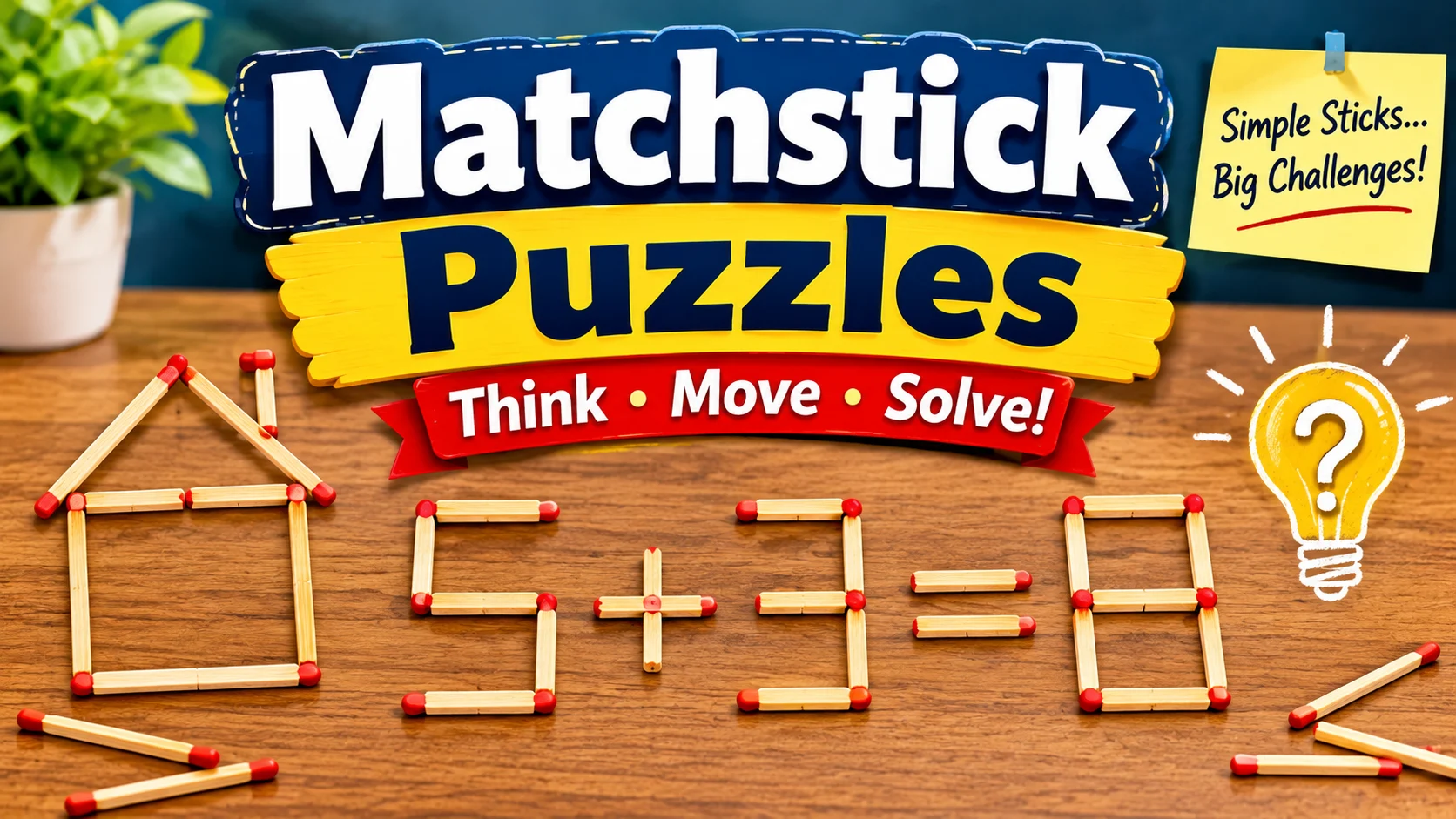
Matchstick puzzles are visual brain teasers in which you move, remove, or add matchsticks to create correct equations or new shapes. These 20 matchstick puzzles include mathematical challenges, square arrangements, and spatial reasoning problems, with hints and step by step solutions.
Can you solve a mathematical equation by moving just one matchstick? Matchstick puzzles are entertaining brain challenges that make you look at familiar numbers and shapes differently. Instead of using complicated calculations, you use observation, creativity, and logical thinking to find a solution.
This collection of matchstick puzzles includes easy challenges for beginners, mathematical puzzles for students, and trickier problems for adults. Some ask you to move one matchstick to correct an equation, while others challenge you to create or count geometric shapes.
Try solving each puzzle before reading its answer. You can also use actual craft sticks or draw the arrangements on paper. Remember, the most important rule is to follow the exact number of moves given in each question.
How Do Matchstick Puzzles Work?
Matchstick puzzles use ordinary matchsticks arranged to represent numbers, mathematical signs, or geometric shapes.
There are three common types:
- Move a matchstick: Take one matchstick from its current position and place it somewhere else.
- Remove a matchstick: Take away the specified number of matchsticks.
- Add a matchstick: Place an additional matchstick to complete an equation or shape.
Some mathematical challenges use a seven segment display arrangement, similar to the digits on a digital clock.
Important puzzle rule: For the equation puzzles below, imagine standard seven segment digits made from matchsticks. A matchstick may be rotated when moved. The equals sign stays unchanged, and every finished equation must be mathematically correct.
20 Matchstick Puzzles to Test Your Brain
Section A: Easy Matchstick Puzzles
Beginner level
Start with these simple challenges. They introduce the basic idea of moving matchsticks to correct mathematical equations.
Puzzle 1 Fix the Incorrect Equation
Easy
Question:
Move exactly one matchstick to make this equation correct:
7 − 1 = 2
Move one matchstick only.
Hint: Look at the first number and the subtraction sign.
Answer: 1 + 1 = 2
Why: Take the top horizontal matchstick from the digit 7. Rotate it vertically and place it on the subtraction sign to turn it into a plus sign. The 7 becomes 1, giving 1 + 1 = 2.
Puzzle 2 Correct the Number Equation
Easy
Question:
Move one matchstick to make this equation true:
7 − 2 = 3
Hint: Can the first number become a different digit?
Answer: 1 + 2 = 3
Why: Remove the top horizontal matchstick from 7 and place it vertically on the minus sign. This changes 7 into 1 and minus into plus.
Puzzle 3 The Missing Mathematical Move
Easy
Question:
Move one matchstick to correct the following:
9 − 1 = 4
Hint: Think about how a 9 can become a 3.
Answer: 3 + 1 = 4
Why: Remove the upper left vertical matchstick from the 9. Move it to the minus sign vertically to make a plus sign. The 9 becomes 3, and the resulting equation is correct.
Puzzle 4 Make the Equation True
Easy
Question:
Move exactly one matchstick:
7 − 5 = 6
Hint: The first number needs to change, and so does the operation.
Answer: 1 + 5 = 6
Why: Take the top horizontal matchstick from 7 and move it vertically onto the minus sign. The first digit becomes 1, and subtraction becomes addition.
Section B: Medium Matchstick Math Puzzles
Intermediate level
These puzzles require more attention to the structure of numbers. Check which matchstick can be transferred without changing the total number of sticks.
Puzzle 5 Change Two Parts With One Move
Difficulty: Medium
Question:
Move one matchstick to correct this equation:
7 − 8 = 9
Hint: Can you turn the first digit into 1?
Answer: 1 + 8 = 9
Why: Remove the top horizontal matchstick from 7 and rotate it to make the minus sign a plus sign. The equation becomes 1 + 8 = 9.
Puzzle 6 Repair the Subtraction
Difficulty: Medium
Question:
Move one matchstick:
9 − 2 = 5
Hint: Look at the upper left part of the first digit.
Answer: 3 + 2 = 5
Why: Remove the upper left vertical stick from 9. Place it vertically on the minus sign to create a plus. The 9 becomes 3, making the equation correct.
Puzzle 7 The Number Transformation
Difficulty: Medium
Question:
Move exactly one matchstick to correct this equation:
9 − 4 = 7
Hint: The first digit can become 3.
Answer: 3 + 4 = 7
Why: Move the upper-left matchstick from 9 to the minus sign. The 9 becomes 3, and the minus sign becomes plus.
Puzzle 8 Find the Correct Addition
Difficulty: Medium
Question:
Move one matchstick to make the equation correct:
9 − 5 = 8
Hint: Change both the first number and the mathematical sign.
Answer: 3 + 5 = 8
Why: Move the upper-left vertical matchstick from 9 onto the minus sign vertically. The result is 3 + 5 = 8.
Puzzle 9 The Matchstick Square Challenge
Difficulty: Medium
Question:
You have seven matchsticks. Can you arrange all seven to create exactly two equal squares?
Hint: The squares can share one side.
Answer: Arrange two squares side by side
Why: Each square normally requires four sides. When two squares share one side, the total is:
4 + 4 − 1 = 7 matchsticks.
Both squares are complete, and all seven sticks are used.
Puzzle 10 Four Triangles From Six Matches
Difficulty: Hard
Question:
Can you make four equal triangles using exactly six matchsticks?
Hint: Do not restrict yourself to a flat arrangement.
Answer: Build a three dimensional triangular pyramid (tetrahedron).
Why: A tetrahedron has four triangular faces and six edges. Use one matchstick for each edge. This works because the matches form a three dimensional structure rather than a flat drawing.
Section C: Hard Matchstick Puzzles
Advanced level
These challenges require more spatial thinking. Pay attention to how many shapes remain after removing matchsticks.
Puzzle 11 Count the Squares
Difficulty: Medium
Question:
Twelve matchsticks are arranged into a two by two grid of equal small squares.
How many complete squares can you find altogether?
Hint: Do not count only the smallest squares.
Answer: Five squares.
Why:
- Four small squares.
- One large square formed by the outside boundary.
Total: 4 + 1 = 5 squares.
Puzzle 12 Remove Two Matchsticks
Difficulty: Hard
Question:
Imagine a two by two square grid made from 12 matchsticks.
Remove exactly two outer matchsticks so that only two small complete squares remain, with no large square.
Hint: Break two small squares on opposite corners.
Answer: Remove the top outer edge of the upper left square and the bottom outer edge of the lower right square.
Why: These two removals destroy the upper left and lower right small squares. The upper right and lower left squares remain complete. The large outer square is also broken.
Puzzle 13 Remove One Matchstick
Difficulty: Medium
Question:
A two by two grid contains four small squares and one large square.
Remove exactly one matchstick so that three complete small squares remain.
Hint: Choose an outside edge, not a shared middle edge.
Answer: Remove any outer boundary matchstick.
Why: Removing an outer edge breaks one small square and the large outside square. The other three small squares remain complete.
Puzzle 14 Build a Larger Square
Difficulty: Medium
Question:
You have 12 matchsticks.
Arrange them to make four equal small squares that also form one larger square.
How should you arrange them?
Hint: Think of a grid with two rows and two columns.
Answer: Make a two by two square grid.
Why: Each small square shares one or more sides with its neighbors. The arrangement requires 12 matchsticks and creates four small squares plus one large square.
Puzzle 15 The Six Match Triangle Challenge
Difficulty: Hard
Question:
Can you use six matchsticks to make four triangles without breaking any matchsticks?
Hint: Think about the difference between two dimensional and three dimensional shapes.
Answer: A tetrahedron.
Why: Six matchsticks form its six edges, creating four triangular faces. The puzzle works in three dimensions.
Section D: Tricky Matchstick Brain Teasers
Challenge level
These final puzzles combine mathematical reasoning, observation, and geometric thinking.
Puzzle 16 Correct the Digital Equation
Difficulty: Medium
Question:
Move exactly one matchstick:
2 − 7 = 3
Hint: Change the 7 into a 1.
Answer: 2 + 1 = 3
Why: Remove the top horizontal matchstick from 7 and place it vertically on the minus sign. The result is a correct addition equation.
Puzzle 17 The Three Square Arrangement
Difficulty: Easy
Question:
How many matchsticks are needed to create three equal squares in one straight horizontal row, with neighboring squares sharing sides?
Hint: The shared sides should not be counted twice.
Answer: 10 matchsticks.
Why: Three separate squares would require 12 sticks. However, the first and second squares share one side, and the second and third squares share another.
12 − 2 = 10.
Puzzle 18 Make a Triangle From Three Matches
Difficulty: Easy
Question:
What is the minimum number of matchsticks required to create one equilateral triangle?
Hint: Count the sides.
Answer: Three matchsticks.
Why: An equilateral triangle has three equal sides, so one matchstick is needed for each side.
Puzzle 19 The Four Square Puzzle
Difficulty: Medium
Question:
You have 16 matchsticks. Arrange them to make four equal squares that do not share sides.
How should you arrange them?
Hint: Keep the squares separate.
Answer: Arrange four individual squares in a row or a two by two pattern, leaving a small gap between them.
Why: Each separate square needs four matchsticks.
4 × 4 = 16.
Puzzle 20 The Matchstick Pyramid
Difficulty: Hard
Question:
Use six matchsticks to create a solid shape with four triangular faces. Every matchstick must be used as an edge.
What shape should you make?
Hint: It is a three dimensional shape with a triangular base.
Answer: Tetrahedron.
Why: A tetrahedron consists of four triangular faces and six edges. One matchstick represents each edge, so all six matchsticks are used.
Tips to Solve Matchstick Puzzles More Easily
If you find matchstick puzzles difficult, try these approaches:
- Study the digits: Learn how seven segment numbers are constructed.
- Check the mathematical signs: A plus can sometimes become a minus, or a minus can become a plus.
- Look for removable segments: Some digits can become other digits after removing just one matchstick.
- Consider three dimensions: Not every shape puzzle must be solved on a flat surface.
- Count shared sides: In square puzzles, adjacent shapes often use the same matchstick.
- Follow the move limit: Moving two sticks when the instruction says one does not count as a correct solution.
Can You Solve the Matchstick Challenge?
Try these five quick questions without looking back at the solutions.
Mini matchstick quiz
5 questions
1. What does a tetrahedron have?
Three triangular faces
Four triangular faces
Five triangular faces
2. How many sticks make two adjacent squares sharing one side?
6
7
8
3. How many squares are in a two by two grid?
4
5
6
4. What is the main rule in a move one match puzzle?
Move exactly one stick
Remove two sticks
Add three sticks
5. What is the minimum number of matches for an equilateral triangle?
2
3
4
Check answers
Replacement Puzzle 20 Three Triangles With Seven Matchsticks
Difficulty: Hard
Question:
Can you arrange exactly seven matchsticks to create three connected equilateral triangles, with neighboring triangles sharing one side?
Hint: Arrange the triangles in a zigzag pattern.
Answer: Create a connected chain of three triangles.
Why: Three separate triangles would need nine matchsticks. When the triangles share two sides, two matchsticks are saved.
9 − 2 = 7.
FAQs
1. What are matchstick puzzles?
Matchstick puzzles are visual brain teasers in which matchsticks are arranged into numbers, mathematical equations, or geometric shapes. The challenge usually involves moving, adding, or removing a limited number of sticks to create a correct equation or target arrangement.
2. How do you solve matchstick puzzles?
Start by examining the numbers and mathematical signs. Look for digits that can change when one matchstick is removed or transferred. For shape puzzles, count shared sides and consider whether the arrangement can be three dimensional.
3. What are the easiest matchstick puzzles for beginners?
Begin with one matchstick equation challenges, simple triangles, and square counting puzzles. These introduce basic matchstick movements without requiring advanced mathematics. Once comfortable, try puzzles involving multiple digits or more complicated geometric arrangements.
4. Are matchstick puzzles good for kids?
Yes. Age appropriate matchstick puzzles can introduce children to basic arithmetic, shapes, spatial reasoning, and logical thinking. Use craft sticks or draw the arrangements on paper instead of giving young children real matches.
5. What are hard matchstick puzzles?
Hard matchstick puzzles typically involve multiple movements, complicated mathematical equations, overlapping shapes, or three-dimensional arrangements. They require solvers to consider several possibilities rather than simply changing one digit.
6. Can you solve matchstick puzzles without moving actual matches?
Yes. You can draw matchstick arrangements on paper, use digital puzzle applications, or study diagrams. The important part is visualizing how the arrangement changes when a matchstick is moved.
7. What is a seven segment matchstick puzzle?
A seven segment puzzle uses seven possible line positions to represent digits from zero to nine, similar to a digital clock. Moving or removing one segment can transform one digit into another and sometimes correct an entire mathematical equation.
8. How many matchsticks are needed to make four triangles?
Six matchsticks can create four triangular faces when arranged into a three dimensional tetrahedron. The six matchsticks form the six edges, and each of the four faces is an equilateral triangle.
Conclusion
Matchstick puzzles are a fun way to explore numbers, mathematical relationships, and geometric shapes through simple visual challenges. Whether you are moving one stick to correct an equation, counting squares in a grid, or creating a three dimensional pyramid, every puzzle encourages you to look beyond the obvious arrangement. Start with the easier questions and gradually attempt the harder challenges. You can also share these matchstick brain teasers with friends, classmates, or family members and see who finds the solutions first. If you enjoy visual reasoning, try exploring more logic puzzles and number challenges next.

Ryan Mitchell is a writer and puzzlesmith who crafts engaging brainteasers, logic puzzles and interactive word games for Puzzlenexa.com. With a deep passion for problem solving, his work focuses on challenging readers, encouraging critical thinking and making complex puzzles accessible and fun for all skill levels.