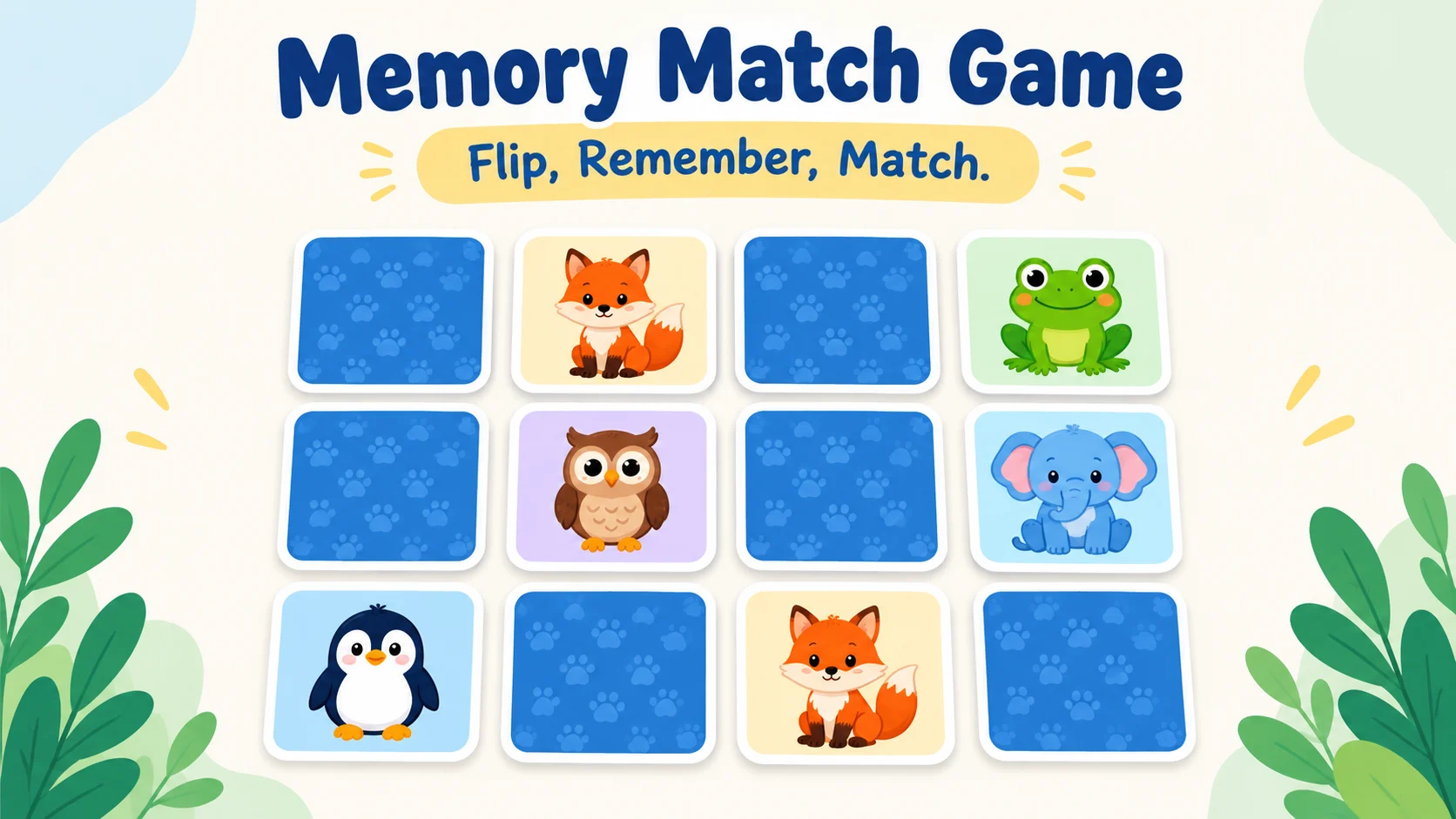
A memory match game is a fun card game in which players flip two hidden cards at a time to find matching pairs. The goal is to remember the position of each picture, match all pairs, and complete the board in as few moves as possible. Memory matching games are suitable for kids, adults, and families, with adjustable difficulty levels for beginners and experienced players.
What Is a Memory Match Game?
A memory match game, also called a memory card game or Concentration, challenges players to remember the positions of hidden pictures, symbols, or words. Players turn over two cards on each move. If the cards match, they remain revealed; otherwise, they are turned face down again.
The objective is to uncover all matching pairs. You can play alone to challenge your own move count or take turns with friends and family.
How to Play a Memory Matching Game

1. Look at the board
Notice where the cards are positioned before you start flipping them.

2. Reveal two cards
Select any two hidden cards and look carefully at their pictures.

3. Find matching pairs
If both cards show the same symbol, the pair is complete. If not, remember the positions.

4. Clear the board
Continue until every pair is matched. Try another round and aim to finish in fewer moves.
Choose the Right Difficulty
| Level | Suggested board | Best for |
|---|---|---|
| Easy | 3 pairs | Beginners and younger players |
| Medium | 6 pairs | Casual players and families |
| Hard | 8 pairs | Players who want a bigger challenge |
These levels are practical starting points, not age or ability assessments. Choose a smaller board if you want a relaxed round, or a larger one if you enjoy remembering more positions.
Tips to Find Matching Pairs Faster
- Scan systematically. Work across the board instead of selecting cards randomly.
- Build location associations. Remember a picture and where it appeared.
- Use each miss as information. A mismatched turn still teaches you where two symbols are located.
- Look before you flip. Pause briefly and recall cards you have already seen.
- Stay consistent. Use the same scanning direction to help organize your observations.
- Prioritize accuracy over speed. A rushed guess may waste a move.
Why Play Memory Match Games?
Memory matching games provide a playful way to practice visual recall, attention, and recognizing identical patterns. They can also encourage turn-taking and patience when played with others.
For children, picture matching can be adapted to familiar animals, shapes, colors, letters, and numbers. For adults, larger boards or word-based pairs can make the activity more challenging.
A game is an enjoyable exercise, not a medical assessment. Playing it does not guarantee improvements in general memory or prevent cognitive decline.
Memory Match Game Challenge
Ready for another way to play? Try one of these variations with a friend, family member, or classroom group.
- Picture challenge: Match animals, fruits, shapes, or everyday objects.
- Word challenge: Match a word to its definition.
- Number challenge: Match simple sums to their answers, such as \(4+3\) and \(7\).
- Team challenge: Take turns finding pairs and count how many each player collects.
- No-repeat challenge: Try to avoid revealing the same known mismatch twice.
Can you beat your best score?
Your score is based on the number of moves needed to find every pair. In a game with eight pairs, eight moves is the theoretical minimum because each move reveals two cards. Reaching that minimum requires knowing the location of every pair before making a move, so use it as a benchmark rather than an expected result.
Challenge a friend to play the same difficulty and compare move counts.
Play Offline With Printable Memory Cards
You can also make a memory matching game at home.
- Create two copies of each picture, word, or symbol.
- Print the cards on paper or cardstock.
- Cut out the cards and shuffle them.
- Place all cards face down in rows.
- Take turns revealing two cards and collecting matching pairs.
For younger players, use a small set of colorful pictures. For older children and adults, try vocabulary, geography, or arithmetic pairs.
FAQs
What is a memory match game?
A memory match game is a card game in which players reveal two hidden cards at a time and search for identical pairs. The aim is to remember card positions, match every pair, and complete the board using as few moves as possible.
How do you play a memory matching game?
Turn over two cards. If their pictures or symbols match, keep them revealed. If they differ, turn them face down again and remember their positions. Repeat until every pair has been found.
Is Memory Match the same as Concentration?
Yes. Memory Match, Concentration, and matching pairs are common names for the same basic game: reveal two cards, check whether they match, and remember their locations. Specific versions may add timers, scoreboards, or different card types.
Can you play a memory match game online for free?
Yes. You can play a browser-based memory match game without buying physical cards. The interactive game on this page offers easy, medium, and hard settings and counts your moves as you uncover the pairs.
What age is a memory matching game suitable for?
Memory matching games can be adapted for different ages. Start with a small number of picture pairs for beginners and younger children, then increase the number of cards or use words and numbers as players become comfortable with the rules.
What are the benefits of memory matching games?
These games encourage players to practice visual recall, sustained attention, pattern recognition, and patience. Playing can be enjoyable and mentally engaging, but it does not guarantee improvements in memory outside the game.
How can I win a memory match game in fewer moves?
Remember the position of every revealed card, scan the board systematically, and use mismatches to build a mental map. Avoid guessing when you already have enough information to identify a known pair.
Can I make a printable memory match game?
Yes. Print two copies of each image or symbol, cut out the cards, shuffle them, and arrange them face down. You can also create educational sets that match words to definitions, numbers to sums, or letters to their counterparts.
Can adults enjoy memory matching games?
Absolutely. Adults can play the classic picture version or increase the challenge with larger boards, unfamiliar symbols, vocabulary, or number pairs. The goal is to make the game appropriately challenging and enjoyable.
Is a memory match game a test of intelligence?
No. A memory matching score reflects performance on a particular game under particular conditions. It is not a standardized intelligence test or a reliable measure of a person’s overall cognitive ability.
Conclusion
A memory match game is a simple, flexible activity for anyone who enjoys finding patterns and remembering details. Play a quick round online, increase the number of pairs as you become comfortable, or make a printable version for family game night or classroom activities.
The best strategy is to pay attention to each card, remember its location, and learn from every turn. Whether you are playing alone or competing with a friend, focus on finding all the pairs and improving your own score. Ready for another round? Shuffle the cards and see if you can finish in fewer moves.

Ryan Mitchell is a writer and puzzlesmith who crafts engaging brainteasers, logic puzzles and interactive word games for Puzzlenexa.com. With a deep passion for problem solving, his work focuses on challenging readers, encouraging critical thinking and making complex puzzles accessible and fun for all skill levels.