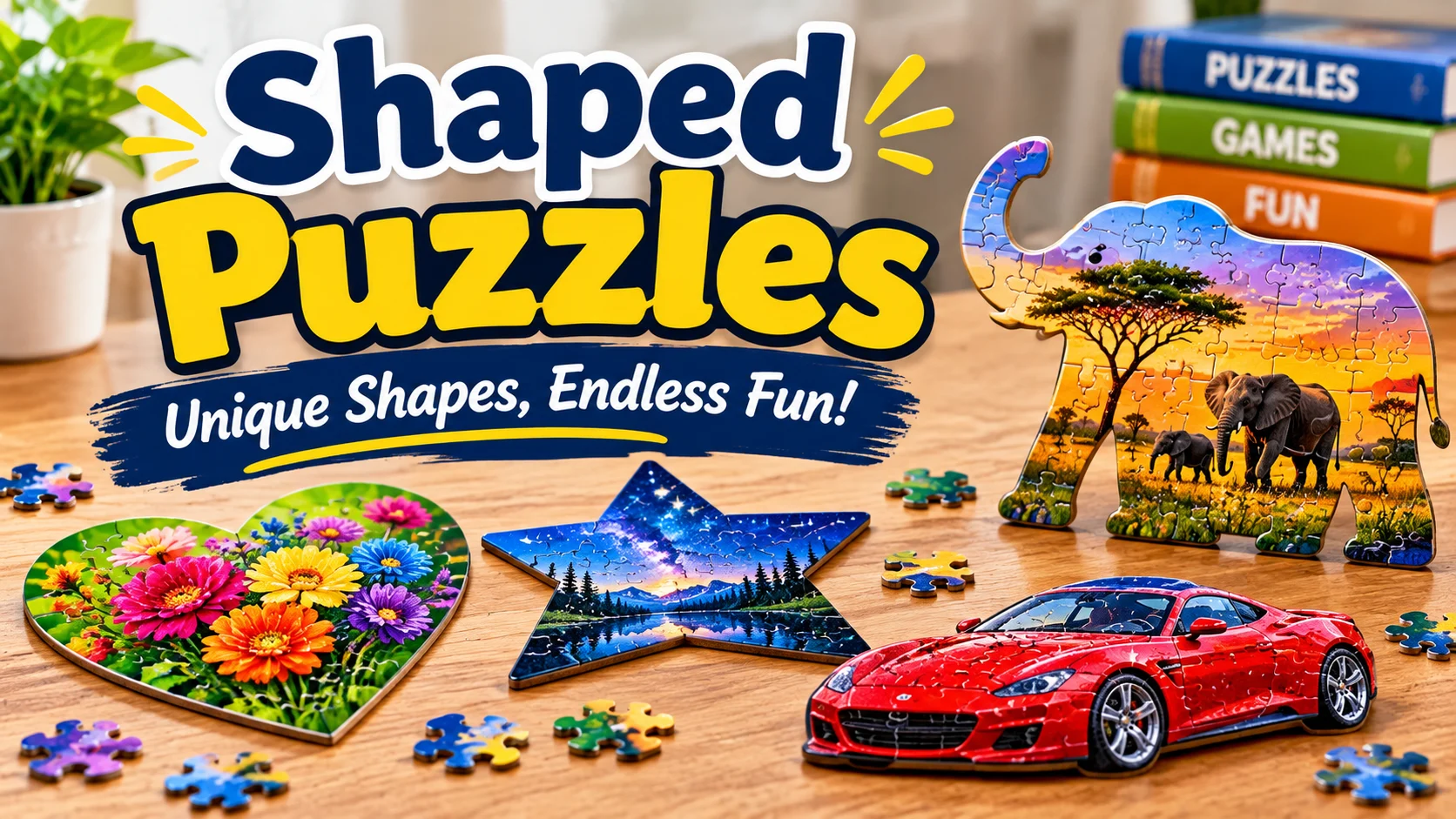
Shaped puzzles are puzzles designed around distinctive forms rather than only traditional rectangular layouts. They include jigsaw puzzles whose outer edges follow an animal, object, or artwork, as well as geometric shape-matching activities and puzzles containing unusual pieces. The right type depends on your age, interests, and desired challenge.
A puzzle does not have to fit inside a rectangle to be enjoyable. Shaped puzzles bring an extra visual challenge by using unusual outlines, recognizable silhouettes, geometric forms, or pieces that fit together in unexpected ways. You might assemble a jigsaw shaped like a butterfly, arrange triangles to make a larger figure, or match silhouettes to their corresponding objects.
These puzzles can appeal to children learning basic shapes, families looking for a shared activity, and adults who want something different from a traditional jigsaw. However, the term can describe several different puzzle styles, so it helps to understand the differences before choosing one. This guide explains the main types, shows you how to solve them, and includes original shape challenges you can try without buying any equipment.
What Are Shaped Puzzles?
Shaped puzzles are puzzles in which the shape of the completed design, the individual pieces, or the arrangement itself is an important part of the challenge.
The term is commonly used for three related but different formats:
1. Shaped jigsaw puzzles
The finished puzzle follows the outline of its subject instead of forming a rectangle. Examples include animal silhouettes, flowers, buildings, and other recognizable forms. Without a conventional straight-edge border, assembly can require a different strategy.
2. Geometric shape puzzles
These use basic forms such as triangles, squares, and parallelograms. The challenge is to arrange the pieces to create a target silhouette or figure. Tangrams are a well-known example.
3. Shape-matching puzzles
These ask the solver to fit a piece into the matching opening, pair an object with its silhouette, or identify which form completes a pattern. They are especially suitable for early shape-recognition activities.
Shaped puzzles versus puzzles with shaped pieces
These phrases sound similar but do not always mean the same thing.
- Shaped puzzle: The outline of the completed puzzle is non-rectangular.
- Puzzle with shaped pieces: The overall puzzle may remain rectangular, but some individual pieces are cut into recognizable forms, such as flowers or animals.
Knowing the distinction helps you find the puzzle you actually want.
Popular Types of Shaped Puzzles
1. Animal-shaped puzzles
Animal-shaped puzzles use familiar outlines such as butterflies, whales, foxes, birds, and turtles. The outer shape gives you an additional clue about where pieces belong, although detailed colors and irregular edges can still make assembly challenging.
Best for: Animal lovers, families, and people who enjoy puzzles with a recognizable finished design.
2. Geometric puzzles
Geometric puzzles use forms such as triangles, squares, rhombuses, and other polygons. Solvers may need to rotate or flip pieces to create a particular silhouette.
Best for: Students, logic enthusiasts, and anyone who enjoys spatial reasoning.
3. Wooden shaped puzzles
Wooden puzzles may use thicker pieces and specially cut outlines. Some include decorative pieces shaped like objects that match the picture, sometimes called whimsy pieces. The exact construction varies by manufacturer.
Best for: People who enjoy tactile puzzles, unusual piece designs, or display-worthy finished artwork.
4. Silhouette and shape-matching puzzles
In a silhouette puzzle, you identify a figure from its outline. In a matching puzzle, you may need to connect a shape with an object, find the missing form, or choose the correct piece for an opening.
Best for: Beginners, children learning shapes, and short visual-thinking activities.
5. Three-dimensional shape puzzles
Three-dimensional puzzles require you to think about how pieces fit in space rather than only on a flat surface. Some form cubes or other solids; others involve interlocking components.
Best for: Solvers who like construction, rotation, and hands-on problem-solving.
How to Choose the Right Shaped Puzzle
Consider these points before choosing a puzzle:
| What to consider | What to look for |
| Age and experience | A simple matching activity for beginners; a more intricate design for experienced solvers |
| Piece count | Fewer pieces for a shorter activity; more pieces for a longer project |
| Visual design | Clear color areas and recognizable details can help with assembly |
| Material | Cardboard, wood, or another material suited to the intended use |
| Puzzle type | A non-rectangular jigsaw, geometric arrangement, or shape-matching activity |
| Intended use | A quick activity, a family game, a learning tool, or a decorative finished puzzle |
For young children, follow the manufacturer’s age guidance and watch for small pieces that could present a choking hazard.
How to Solve Shaped Jigsaw Puzzles
A standard rectangular jigsaw often starts with the corners and straight edges. A shaped jigsaw may have no conventional border, so use a different approach.
- Study the completed picture. Notice its overall silhouette and identify distinctive areas such as eyes, petals, windows, or contrasting colors.
- Sort by visual clues. Group pieces with similar colors, textures, or recognizable details rather than relying only on edge shape.
- Build small sections. Connect pieces that clearly belong together, then combine those sections as the image develops.
- Use the outline as a check. As the puzzle grows, compare its outer contour with the reference image or guide.
- Rotate pieces patiently. A piece may match the right area but need to be turned before it fits.
- Check the finished silhouette. Confirm that the outer edges and internal image both look consistent before calling it complete.
Tip: If you are new to shaped jigsaws, start with a smaller puzzle that has clear visual details. A large piece count is not the only measure of difficulty; the outline and artwork also affect the challenge.
Five Original Shape Puzzles to Try
These short challenges are inspired by shape recognition and spatial reasoning. They are not physical jigsaw layouts, so you can solve them using the descriptions alone.
Can you solve all five?
0 of 5 revealed
Try each question before revealing its answer.
Puzzle 1: The missing shape
Easy
A pattern follows this order: circle, triangle, circle, triangle, circle, ___. Which shape comes next?Reveal answer
Puzzle 2: The four-corner clue
Easy
A flat shape has four equal sides and four right angles. What is it?Reveal answer
Puzzle 3: The triangle count
Medium
How many small triangles make up a larger triangle when each side is divided into two equal sections and the midpoints are connected?Reveal answer
Puzzle 4: The rotation test
Medium
A square is turned 45 degrees on a flat table. Does it become a different geometric shape?Reveal answer
Puzzle 5: The silhouette puzzle
Medium
You see a silhouette with a long neck, four long legs, and a small head with two horn-like shapes. Which animal is a plausible match?Reveal answer
Reveal allTry again
What Skills Can Shaped Puzzles Practise?
Different puzzle formats exercise different kinds of thinking. For example:
- Shape recognition: Noticing and naming forms.
- Spatial reasoning: Imagining how pieces might fit after rotation.
- Visual discrimination: Comparing outlines, colors, and small details.
- Pattern recognition: Identifying a rule in a sequence.
- Planning and persistence: Trying a strategy, checking the result, and adjusting when a piece does not fit.
The specific skills involved depend on the activity. A shape sorter, a silhouette challenge, and a complex shaped jigsaw do not require exactly the same abilities.
Common Mistakes to Avoid
- Confusing shaped puzzles with shaped pieces: Check whether the whole puzzle has an unusual outline or only some pieces do.
- Choosing by piece count alone: Artwork, piece design, and the absence of a straight border can change the difficulty.
- Forcing a piece into place: A genuine fit should match both the contour and the image.
- Ignoring age guidance: Select a suitable format and size for the intended solver.
- Expecting every silhouette to have only one answer: If the clues are too general, several objects or animals may fit. A fair puzzle needs enough detail to support its intended solution.
FAQs
What are shaped puzzles?
Shaped puzzles are activities in which the outline of the finished design, the shapes of the pieces, or the arrangement of forms is central to solving. Examples include animal-shaped jigsaws, tangrams, wooden shape sorters, and silhouette-matching games.
How are shaped puzzles different from regular jigsaw puzzles?
A shaped jigsaw follows the outline of its subject rather than forming a standard rectangle. This means it usually lacks the familiar straight-edge border that many people use to begin a traditional jigsaw.
Are shaped puzzles good for children?
They can be suitable for children when the puzzle matches their age and abilities. Simple shape matching may introduce basic forms, while more complex activities involve visual comparison and spatial reasoning. Follow the manufacturer’s age guidance and keep small pieces away from young children.
Are shaped puzzles harder than regular puzzles?
They can be, particularly when the finished jigsaw has no straight edges or corners to guide the starting point. However, difficulty also depends on piece count, image detail, piece design, and the solver’s experience. A simple shape-matching game may be easier than a standard jigsaw.
What types of shaped puzzles are available?
Common types include animal-shaped and object-shaped jigsaws, geometric arrangement puzzles, tangrams, silhouette puzzles, wooden shape-matching boards, and three-dimensional interlocking puzzles. These formats involve different tasks, so choose based on whether you prefer visual recognition, construction, or traditional piece assembly.
How do you solve a shaped jigsaw puzzle?
Begin by studying the picture and grouping pieces by color, texture, or recognizable details. Build small sections, rotate pieces when necessary, and use the outline as a guide as the puzzle develops. Unlike a rectangular jigsaw, a shaped puzzle may not have a conventional border to build first.
What is the difference between a tangram and a shaped jigsaw?
A tangram is a geometric puzzle that uses a set of flat pieces traditionally seven to form silhouettes or other designs. A shaped jigsaw usually assembles interlocking pieces into a particular image whose completed outer boundary may follow the subject.
Can shaped puzzles be used as decorations?
Yes. Some completed shaped jigsaws can be displayed as decorative artwork. Because their outlines may not fit standard rectangular frames, consider a suitable mounting method or a shadow-box-style frame, and check that the puzzle can be safely supported.
What should I look for when buying a shaped puzzle?
Check the intended age range, piece count, material, image clarity, dimensions, and puzzle format. Confirm whether the entire puzzle is shaped or only some of its pieces are. For beginners, a smaller design with distinctive colors and recognizable details can be a sensible starting point.
Conclusion
Shaped puzzles offer a fresh way to enjoy jigsaws, geometry, and visual problem-solving. Some stand out because the finished design follows an animal or object, while others challenge you to arrange geometric pieces or match a silhouette. The best choice depends on the solver’s experience, interests, and preferred type of challenge. Start with a simple design, study the shapes carefully, and work outward from recognizable details. If you enjoyed the five mini challenges, try a tangram or a small shaped jigsaw next and share the challenge with someone who enjoys solving puzzles.

Ryan Mitchell is a writer and puzzlesmith who crafts engaging brainteasers, logic puzzles and interactive word games for Puzzlenexa.com. With a deep passion for problem solving, his work focuses on challenging readers, encouraging critical thinking and making complex puzzles accessible and fun for all skill levels.