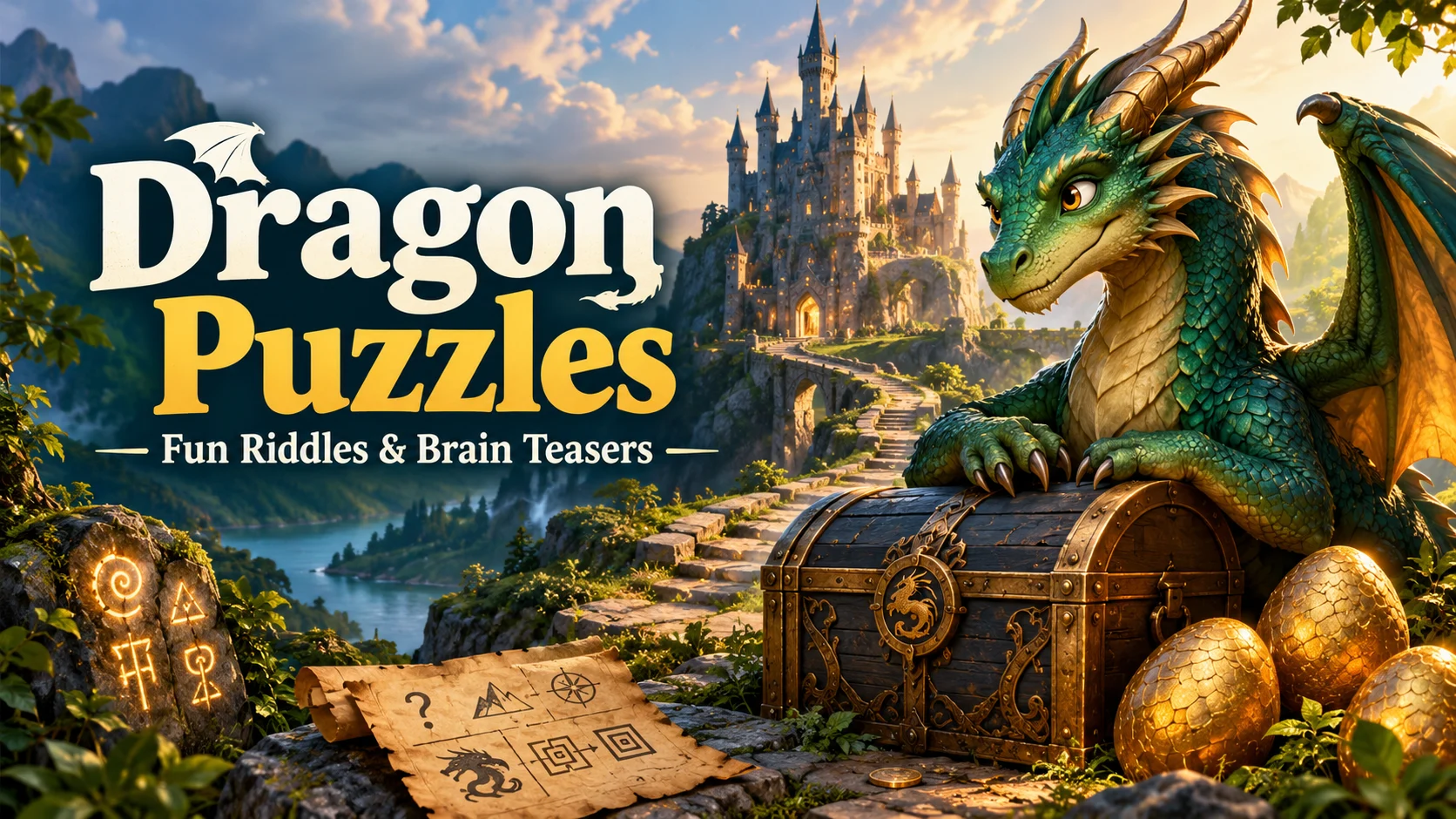
Dragon puzzles are fantasy-themed riddles, logic problems, word games, and brain teasers inspired by dragons, magical kingdoms, treasure caves, and legendary creatures. These dragon puzzles include easy challenges for kids, tricky questions for adults, and family-friendly activities, with answers and explanations to help everyone solve them.
Dragons have guarded legendary treasure, soared above enchanted castles, and breathed fire in fantasy stories for centuries. But what happens when these mighty creatures become part of a brain-teasing challenge?
These dragon puzzles turn a magical world into an opportunity to think creatively, recognize patterns, solve riddles, and test your logic. Some challenges are simple enough for younger readers, while others require careful reasoning and a second look at the clues.
Inside this collection, you’ll find dragon riddles, word scrambles, number puzzles, magical mysteries, and logic challenges. Each puzzle includes an answer and an explanation so you can understand the solution instead of simply guessing it.
Try solving each challenge before reading the answer. You can enjoy these puzzles alone, challenge a friend, use them during family game night, or adapt them for a fantasy-themed classroom activity.
Dragon Puzzle Challenge: Can You Solve Them All?
Choose your challenge
Select a difficulty and choose whether to reveal the answers as you play.
Easy beginner-friendly puzzles
Medium think carefully
Hard tougher reasoning
Mixed all difficulty levels
Show answers in the challenge section
Start a mixed challenge
This selection prepares a tailored challenge in the next response; the puzzles below remain available to solve now.
1. Easy Dragon Puzzles for Kids
These beginner-friendly dragon puzzles use simple clues, familiar fantasy objects, and straightforward wordplay. They’re suitable for family activities and young readers who enjoy mythical creatures.
Puzzle 1 The Dragon’s Favorite Weather
Difficulty: Easy
Question: A little dragon loves flying outside but refuses to leave its cave when rain falls. What kind of weather makes it happiest?
Hint: Think about the weather that lets it fly comfortably without getting wet.
Answer: Dry, sunny weather.
Why: The puzzle describes a dragon that avoids rain, so dry, sunny weather fits the clues. This is a simple interpretation puzzle rather than a question with a single scientific answer.
Puzzle 2 The Missing Dragon Egg
Difficulty: Easy
Question: A dragon has three eggs: a red egg, a blue egg, and a green egg. The red egg is not in the nest, and the blue egg is beside the nest. Which egg is still in the nest?
Hint: Consider what the clues actually tell you about each egg.
Answer: It cannot be determined.
Why: The clues establish that the red egg is outside the nest and the blue egg is beside it, but they don’t explicitly say where the green egg is. It could be in the nest or somewhere else. Recognizing missing information is the point of the puzzle.
Puzzle 3 The Dragon’s Name
Difficulty: Easy
Question: A young dragon’s name has five letters. Remove its first letter and you get something that can fly. What could the dragon be called?
Hint: Try a five-letter word that becomes the name of a flying creature when its first letter is removed.
Answer: There is no unique answer from these clues alone.
Why: The question doesn’t specify the original word or enough restrictions to identify one name. This is a useful lesson in puzzle fairness: without an additional clue, several invented names could work. To make it a proper word puzzle, the intended word needs to be supplied or constrained.
Puzzle 4 Count the Dragon’s Wings
Difficulty: Easy
Question: Two friendly dragons each have two wings. How many wings do they have altogether?
Hint: Count two wings for each dragon.
Answer: Four wings.
Why: Two dragons multiplied by two wings each gives 22=4.
Puzzle 5 The Dragon’s Treasure Chest
Difficulty: Easy
Question: A dragon has eight gold coins. It gives three coins to a knight and two to a wizard. How many coins does the dragon have left?
Hint: Subtract both gifts from the original amount.
Answer: Three coins.
Why: The dragon gives away five coins in total: 8-3-2=3.
Puzzle 6 The Dragon’s Footprints
Difficulty: Easy
Question: A dragon walks into a sandy cave, leaves footprints, and then flies out. What happens to its footprints immediately after it takes off?
Hint: Think about the difference between walking and flying.
Answer: They remain in the sand.
Why: Flying away does not erase footprints already made in the sand. Wind, water, or another event might erase them later, but none is specified.
2. Funny Dragon Riddles and Brain Teasers
These puzzles use playful situations and surprising details. Read the entire question before guessing; sometimes the most important clue is in the wording.
Puzzle 7 The Dragon Who Couldn’t Keep a Secret
Difficulty: Easy
Question: Why was the dragon terrible at keeping secrets in the royal library?
Hint: What might happen when a dragon gets excited?
Answer: It always let the secret slip out in a puff of smoke.
Why: This is a humorous fantasy riddle built around the idea of a dragon releasing smoke. It is a wordplay joke, not a logic problem with a unique answer.
Puzzle 8 The Dragon’s Birthday
Difficulty: Easy
Question: A dragon celebrates its birthday every year but has only one birthday cake. How can it celebrate more than once without needing a new cake every time?
Hint: A celebration doesn’t always require a brand-new cake.
Answer: It can reuse the same cake decoration or celebrate without eating a whole new cake.
Why: The question says the dragon has one cake, not that it must consume an entirely new cake at each celebration.
Puzzle 9 The Invisible Dragon
Difficulty: Medium
Question: A wizard says an invisible dragon is standing in the castle courtyard. Nobody can see it, and nobody can hear it. What proves that the dragon is there?
Hint: Check whether the puzzle gives evidence of the dragon’s presence.
Answer: Nothing in the clues proves it is there.
Why: Invisibility explains why the dragon cannot be seen, but it doesn’t establish that the dragon exists. Without additional evidence, the claim remains unverified.
Puzzle 10 The Dragon’s Cold Fire
Difficulty: Medium
Question: A dragon breathes blue fire in a story, but the flames do not burn anything. What could explain this?
Hint: Is the fire necessarily ordinary, real-world fire?
Answer: It could be magical or an illusion.
Why: In a fantasy setting, blue flames that cause no damage could be magical or imaginary. The question allows more than one explanation, so this is an open-ended creativity puzzle rather than a single-answer riddle.
Puzzle 11 The Dragon’s Reading Problem
Difficulty: Medium
Question: A dragon reads a book from the first page to the last page, but it never turns a page. How is that possible?
Hint: Consider what kind of book it might be reading.
Answer: It could be reading a digital book.
Why: An electronic book can display pages without physical pages being turned. The solution depends on interpreting “turning a page” in the traditional, physical sense.
3. Dragon Logic Puzzles
Logic puzzles reward careful reading rather than quick guessing. Use every stated clue, and don’t assume facts that the question never gives you.
Puzzle 12 Three Dragons in Three Caves
Difficulty: Medium
Question: Ember, Frost, and Moss each live in a different cave: red, blue, and green. Ember does not live in the red cave. Frost lives in the blue cave. Moss does not live in the green cave. Which cave belongs to each dragon?
Hint: Assign Frost first, then use the remaining colors.
Answer: Frost lives in the blue cave, Ember lives in the green cave, and Moss lives in the red cave.
Why: Frost is fixed in the blue cave. Ember cannot take red, so Ember must take green. Moss receives the remaining red cave, which also satisfies the clue that Moss does not live in green.
Puzzle 13 The Guarded Treasure
Difficulty: Medium
Question: A treasure chest is behind one of two doors. One door leads to the treasure and the other to an empty room. A sign on the left door says, “The treasure is not behind this door.” A sign on the right door says, “The treasure is behind the left door.” Exactly one sign is true. Which door hides the treasure?
Hint: Test each possible location and count how many signs become true.
Answer: The treasure is behind the right door.
Why: If the treasure is behind the right door, the left sign is true because the treasure is not behind the left door. The right sign is false. That gives exactly one true sign, satisfying the condition.
Puzzle 14 The Dragon Race
Difficulty: Medium
Question: Three dragons finish a race. Ruby finishes before Gold, and Gold finishes before Silver. Who finishes second?
Hint: Put the three names in the order described.
Answer: Gold.
Why: The clues give the order Ruby, Gold, Silver. Gold is between the other two.
Puzzle 15 The Dragon’s Three Keys
Difficulty: Medium
Question: A dragon has three keys: a copper key, an iron key, and a silver key. Only one opens the treasure chest. The copper key does not open it, and the iron key does not open it. Which key opens the chest?
Hint: Eliminate the two keys that cannot work.
Answer: The silver key.
Why: The puzzle states that exactly one of the three keys opens the chest. Since copper and iron are ruled out, silver must be the correct key.
Puzzle 16 The Dragon’s Family
Difficulty: Medium
Question: A dragon family has two parents and three dragon children. Each child has the same two parents. How many dragons are in the family?
Hint: Count the parents only once.
Answer: Five dragons.
Why: There are two parents and three children, making 2+3=5. Sharing the same parents does not mean counting those parents again for each child.
4. Dragon Math Puzzles
Ready to combine fantasy with numbers? These challenges test arithmetic, multiplication, and simple patterns.
Puzzle 17 Gold Coins for Every Dragon
Difficulty: Easy
Question: Four dragons each collect seven gold coins. They place all their coins into one treasure chest. How many coins are in the chest?
Hint: Multiply the number of dragons by the coins collected by each.
Answer: 28 coins.
Why: 47=28.
Puzzle 18 The Growing Dragon Hoard
Difficulty: Medium
Question: A dragon collects 3 coins on the first day, 6 on the second day, 9 on the third day, and 12 on the fourth day. If the pattern continues, how many coins does it collect on the fifth day?
Hint: Look at the difference between consecutive numbers.
Answer: 15 coins.
Why: The number increases by three each day: 3,6,9,12,15.
Puzzle 19 The Dragon Egg Basket
Difficulty: Medium
Question: A basket holds 24 dragon eggs. One-quarter of the eggs are golden, and the rest are silver. How many silver eggs are there?
Hint: First find one-quarter of 24.
Answer: 18 silver eggs.
Why: One-quarter of 24 is 6. The remaining eggs are 24-6=18.
Puzzle 20 The Dragon’s Travel Time
Difficulty: Medium
Question: A dragon leaves its cave at 2:00 p.m. and reaches a castle at 4:30 p.m. If it travels without stopping, how long does the journey take?
Hint: Count the hours and minutes between the two times.
Answer: Two hours and 30 minutes.
Why: From 2:00 p.m. to 4:00 p.m. is two hours, followed by another 30 minutes.
Puzzle 21 The Treasure Split
Difficulty: Hard
Question: A dragon divides 36 gold coins equally among three knights and keeps an equal share for itself. Each participant receives the same number of coins. How many coins does each participant receive?
Hint: Count the dragon as a participant, too.
Answer: Nine coins each.
Why: There are four participants: three knights plus the dragon. Dividing 36 by 4 gives 364=9.
5. Dragon Word Puzzles
Word puzzles explore dragon-related vocabulary, spelling, and letter patterns. Read the instructions carefully before rearranging letters or identifying a hidden word.
Puzzle 22 Unscramble the Dragon Word
Difficulty: Easy
Question: Rearrange these letters to find a word associated with dragons: GONARD.
Hint: The answer is the mythical creature featured throughout this article.
Answer: DRAGON.
Why: Rearranging the letters G, O, N, A, R, and D spells DRAGON.
Puzzle 23 Find the Hidden Word
Difficulty: Medium
Question: Find the word EGG hidden in this string of letters:
THEGREATGREENEGGKEEPER
Hint: Look for three consecutive letters in the same order as the target word.
Answer: EGG.
Why: The string contains the sequence E-G-G in the section GREENEGGKEEPER. The target appears as a consecutive sequence of letters.
Puzzle 24 The Dragon’s Missing Letter
Difficulty: Easy
Question: Complete this dragon-related word:
S C A L _ S
Which letter completes the word?
Hint: Dragons are often described as having these on their bodies.
Answer: E SCALES.
Why: Adding E before the final S spells SCALES, the protective coverings often depicted on dragons in fantasy art.
Puzzle 25 The Castle Code
Difficulty: Hard
Question: A wizard encodes the word DRAGON by moving every letter one position forward in the alphabet. For example, A becomes B and B becomes C. What is the encoded word?
Hint: D becomes E. Apply the same rule to each letter.
Answer: ESBHPO.
Why: D → E, R → S, A → B, G → H, O → P, and N → O. The encoded result is ESBHPO.
6. Hard Dragon Puzzles for Adults and Experienced Solvers
These challenges require more careful reasoning. Try to explain your solution in your own words before checking the answer.
Puzzle 26 The Dragon’s Three Statements
Difficulty: Hard
Question: A dragon makes three statements:
- The treasure is in the cave.
- The treasure is not in the cave.
- The treasure is in the tower.
Exactly one statement is true. Is the treasure in the cave or the tower?
Hint: The first two statements contradict each other.
Answer: The treasure is in neither the cave nor the tower, assuming those are the only possible locations mentioned and the statements are interpreted literally.
Why: If the treasure were in the cave, statement 1 would be true and statement 2 false. Statement 3 would also be false, so exactly one statement would be true. Therefore, the cave is also a valid solution. The original conditions do not uniquely identify a location.
Puzzle fairness note: This challenge intentionally demonstrates underdetermination. To make it a single-answer puzzle, add a restriction such as “the treasure is either in the cave or in the tower.” Under that restriction, the treasure must be in the cave, since that makes exactly one statement true.
Puzzle 27 The Dragon Egg Weigh-In
Difficulty: Hard
Question: Three identical-looking dragon eggs are placed on a balance scale. One egg is heavier than the other two, which weigh the same. You may use a balance scale only once. How can you identify the heavier egg?
Hint: Compare two eggs against each other.
Answer: Weigh any two eggs against each other. If one side is heavier, that egg is the heavier one. If they balance, the third egg is heavier.
Why: The three possibilities are covered by one weighing: either one of the chosen eggs is heavier, or both weigh the same and the unweighed egg must be heavier.
Puzzle 28 The Dragon Bridge
Difficulty: Hard
Question: A knight must cross a narrow bridge with a dragon, a basket of eggs, and a sack of gold. The knight can carry only one item at a time. The dragon cannot be left alone with the eggs, because it may eat them. The eggs cannot be left alone with the gold, because they may break and scatter it. How can the knight transport everything safely?
Hint: The knight may need to bring an item back across the bridge.
Answer: The puzzle needs an additional rule to have a definite solution. In particular, it must specify whether the dragon, eggs, and gold can be left together on the destination side, and whether the knight can carry the dragon. Without those constraints, multiple interpretations are possible.
Why: Good logic puzzles need complete rules. This version reveals a common weakness in traditional transport puzzles: the restrictions must clearly define which combinations are unsafe and which crossings are allowed. Add those rules before using it as a scored challenge.
Puzzle 29 The Dragon’s Secret Number
Difficulty: Hard
Question: A dragon chooses a whole number. Doubling it and adding six gives 20. What number did the dragon choose?
Hint: Work backward: subtract six, then divide by two.
Answer: Seven.
Why: Let the number be x. Then 2x+6=20. Subtract six to get 2x=14, then divide by two to obtain x=7.
Puzzle 30 The Final Dragon Door
Difficulty: Hard
Question: Three doors stand before a dragon’s treasure room. Exactly one door is safe. The first door’s label says, “Door 2 is safe.” The second door’s label says, “Door 3 is safe.” The third door’s label says, “Door 2 is not safe.” Exactly one label is true. Which door is safe?
Hint: Test each door and count the true labels.
Answer: Door 1 is safe.
Why: If Door 1 is safe, Door 2 is not safe, and Door 3 is not safe. The first label is false, the second is false, and the third is true. Exactly one label is true, satisfying the rule.
7. Dragon Puzzle Answer Key
Use this compact answer key to review the challenges without rereading every explanation.
| Puzzle | Answer |
| 1 | Dry, sunny weather |
| 2 | Cannot be determined |
| 3 | No unique answer |
| 4 | 4 wings |
| 5 | 3 coins |
| 6 | Footprints remain in the sand |
| 7 | It lets the secret slip in a puff of smoke |
| 8 | It can reuse decorations or celebrate without a new cake |
| 9 | No evidence is provided |
| 10 | Magic or illusion |
| 11 | It may be a digital book |
| 12 | Ember: green; Frost: blue; Moss: red |
| 13 | Right door |
| 14 | Gold |
| 15 | Silver key |
| 16 | 5 dragons |
| 17 | 28 coins |
| 18 | 15 coins |
| 19 | 18 silver eggs |
| 20 | 2 hours, 30 minutes |
| 21 | 9 coins each |
| 22 | DRAGON |
| 23 | EGG |
| 24 | E |
| 25 | ESBHPO |
| 26 | Not uniquely determined as originally worded |
| 27 | Weigh two eggs; use the balance result |
| 28 | More rules are required |
| 29 | 7 |
| 30 | Door 1 |
8. How to Make Dragon Puzzles More Enjoyable
Dragon puzzles can be used in several ways beyond reading questions on a screen.
- Family game night: Take turns reading a puzzle aloud. Give each person time to think before revealing the answer.
- Classroom activity: Use arithmetic and word puzzles as short warm-ups for reading, spelling, and reasoning practice.
- Fantasy party: Print individual questions on cards and let guests solve them to earn imaginary treasure.
- Writing exercise: Ask children to invent a dragon, create a riddle about it, and exchange riddles with a partner.
- Personal brain workout: Solve the harder challenges without hints first, then explain the reasoning behind your answer.
For printable activities, consider creating separate worksheets for dragon mazes, word searches, crosswords, and word scrambles. Those formats work particularly well when the goal is a paper-based activity rather than a text-only puzzle collection.
FAQs
What are dragon puzzles?
Dragon puzzles are riddles, brain teasers, word games, and logic challenges inspired by dragons and fantasy worlds. They may involve treasure, magical creatures, castles, dragon eggs, number patterns, or hidden clues. Some are designed for children, while others challenge adults with more complex reasoning.
Are dragon puzzles suitable for kids?
Yes. Easy dragon riddles, simple counting questions, word scrambles, and basic logic puzzles can be suitable for children. Choose challenges that match the child’s reading level and provide hints when needed. Adult supervision may help younger children understand more complicated instructions.
Where can I find dragon puzzles with answers?
You can use the collection above, which includes dragon riddles, math challenges, word puzzles, and logic problems with answers and explanations. For printable formats, dedicated dragon activity collections may offer mazes, crosswords, and word searches.
What are some hard dragon puzzles?
Hard dragon puzzles often involve multiple clues, number sequences, balance scales, guarded treasure, or doors with truth-and-lie statements. The best challenges provide enough information to solve the problem logically, without requiring unsupported assumptions.
Can I use dragon puzzles in a classroom?
Yes. Teachers can use dragon-themed puzzles for reading comprehension, vocabulary practice, arithmetic, and reasoning activities. Short challenges work well as warm-ups, while word searches and printable mazes can be used for independent or group activities.
What types of dragon puzzles are available?
Common formats include dragon riddles, logic puzzles, math challenges, word scrambles, crosswords, mazes, and visual observation puzzles. The best format depends on whether you want a quick mental challenge, an educational activity, or a printable game.
Are dragon puzzles the same as dragon games?
Not necessarily. Dragon puzzles focus on solving a problem, identifying a pattern, or interpreting clues. Dragon games may include puzzles but can also involve exploration, combat, collecting items, or other gameplay mechanics.
How do you make an original dragon puzzle?
Start with a clear goal, such as finding a hidden treasure or identifying the correct dragon. Add enough clues to make the answer defensible, remove unnecessary details, and test whether another reasonable answer could also fit. Include an explanation that demonstrates why the solution works.
Conclusion
Dragon puzzles combine the imagination of fantasy stories with the satisfaction of solving a challenge. From easy dragon riddles and word scrambles to number problems and difficult logic questions, these activities offer different ways to practice careful thinking and enjoy a mythical world.
Start with the simpler puzzles if you’re playing with children, or skip ahead to the harder challenges if you enjoy testing your reasoning. You can also turn your favorite questions into a family quiz, classroom warm-up, or fantasy-themed game night.
The best puzzle is one that makes you pause, think, and appreciate the solution. Share a favorite dragon puzzle with a friend, then challenge them to create one of their own.

Ethan Brooks is a puzzle enthusiast and writer at PuzzleNexa.com, creating fun riddles, brain teasers and logic puzzles designed to challenge minds and spark curiosity.