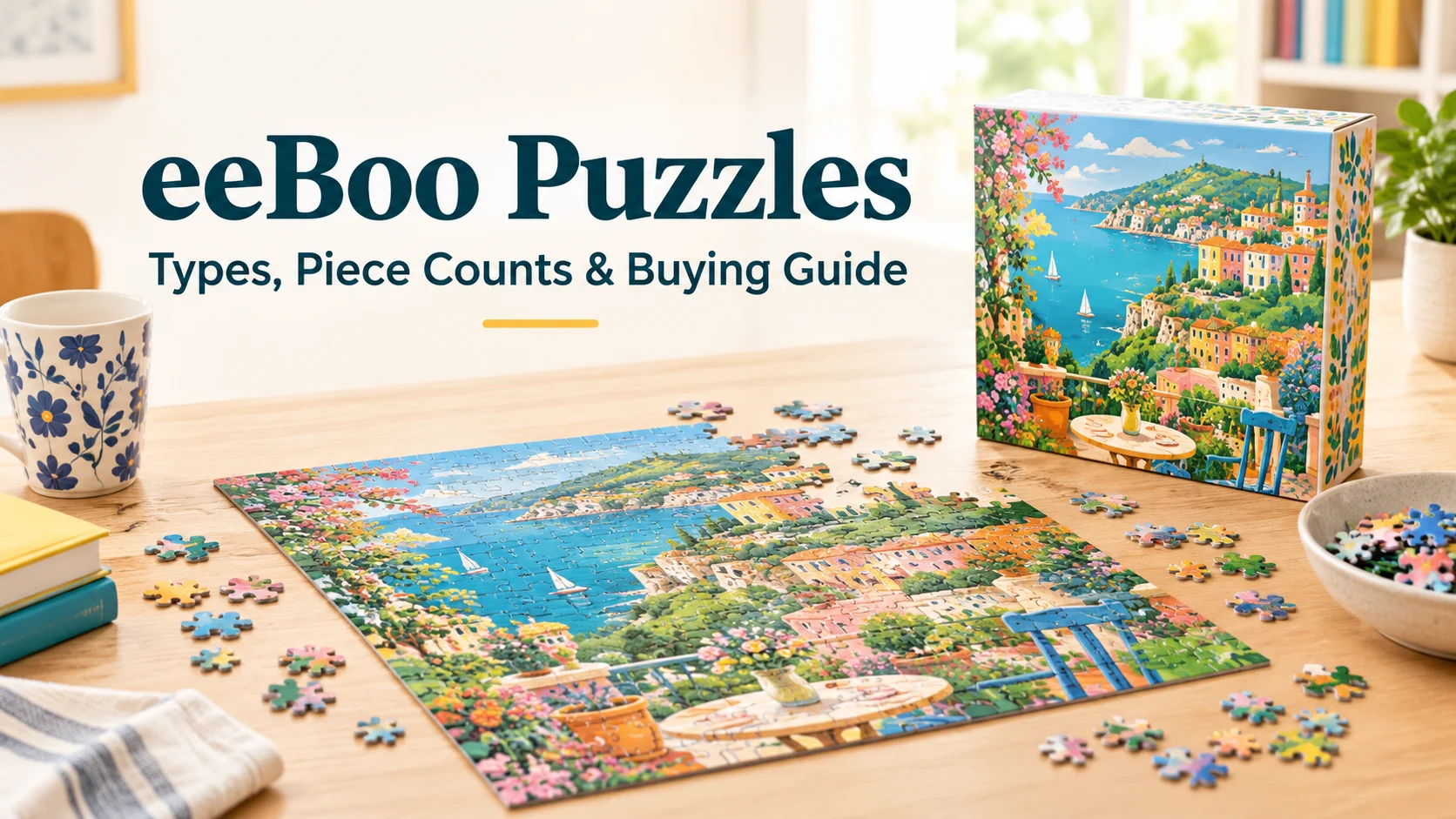
eeBoo puzzles are illustrated jigsaw puzzles and other puzzle-based products designed for different ages, interests, and skill levels. The brand offers options ranging from small-piece children’s puzzles to 500- and 1,000-piece jigsaws for older puzzlers and adults. The best choice depends on age, experience, artwork preferences, and intended use.
A good jigsaw puzzle can turn a quiet afternoon into an enjoyable challenge, encourage families to spend time together, or give a puzzle enthusiast a relaxing project. eeBoo puzzles are worth exploring if you’re looking for illustrated designs, different piece counts, or puzzle activities that suit a range of ages.
The brand’s collection includes smaller puzzles, educational options, and more demanding jigsaws featuring detailed scenes. Its Piece & Love range also offers larger-format puzzles intended for older teens and adults.
However, choosing the right puzzle involves more than picking an attractive picture. Piece count, the age recommendation printed on the box, the complexity of the artwork, and the experience of the person solving it all matter.
This guide explains the main types of eeBoo puzzles, how to compare their piece counts, what to consider before buying, and how to select an option for a child, family, adult puzzler, or gift recipient.
What Are eeBoo Puzzles?
eeBoo is a brand that sells illustrated puzzles, games, toys, educational products, and creative activities. Its official puzzle collections include products for younger children as well as larger jigsaw puzzles marketed toward older audiences.
The brand is particularly relevant to shoppers who value artwork as part of the puzzle-solving experience. Rather than evaluating a puzzle solely by its number of pieces, buyers can also consider its subject, illustration style, learning theme, and suitability for the intended solver.
Three characteristics are especially useful when comparing products:
- Artwork: Choose a scene or subject the puzzler will genuinely enjoy.
- Piece count: Consider how much challenge and solving time the person wants.
- Intended age: Follow the manufacturer’s recommendation and consider the child’s individual abilities.
Not every eeBoo puzzle serves the same purpose. A small puzzle for a preschooler and a detailed 1,000-piece jigsaw require different levels of coordination, patience, and visual reasoning.
Types of eeBoo Puzzles to Explore
The official website organizes puzzles by piece count, age category, and collection. The following categories provide a practical starting point for browsing.
1. Small-piece puzzles for young children
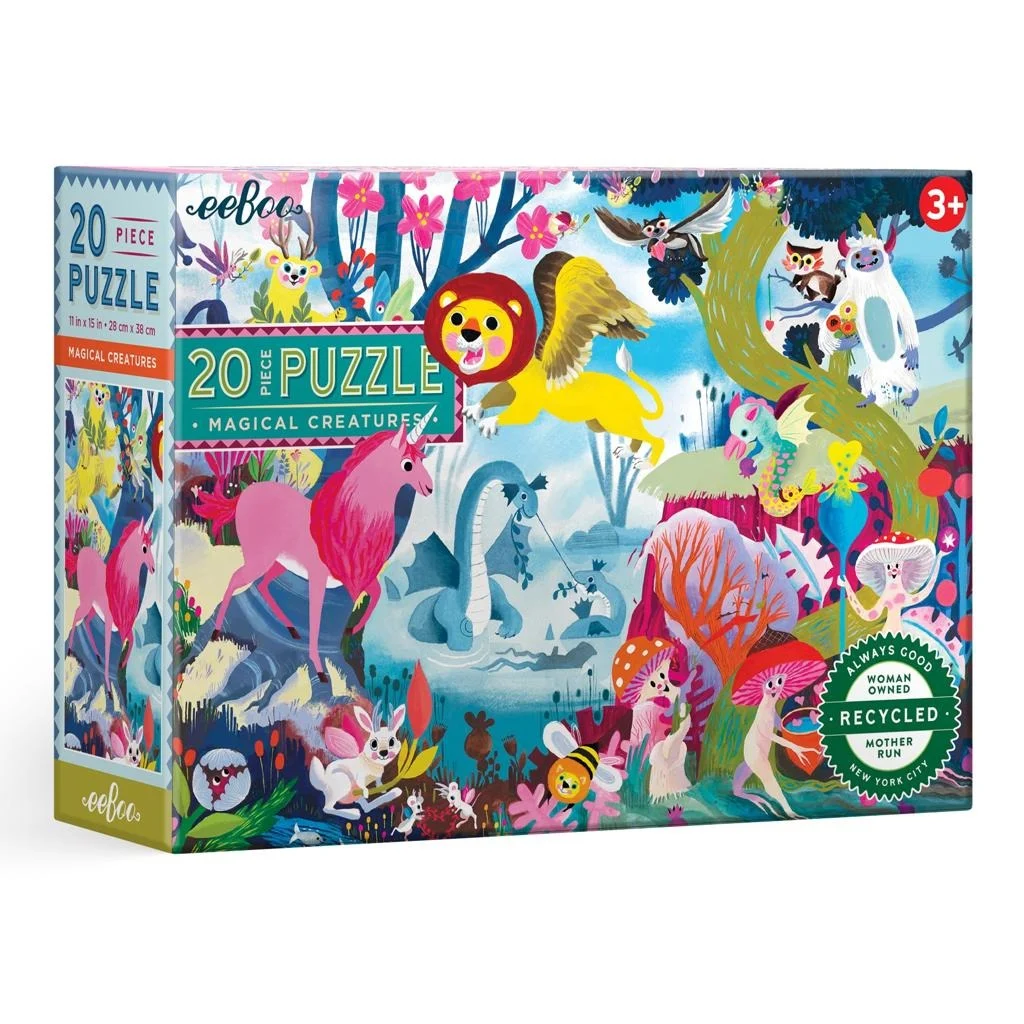
Small-piece puzzles can be a sensible starting point for children who are developing early matching and puzzle-solving skills.
When browsing, look for:
- A manufacturer-recommended age that matches the child.
- Pieces that are manageable for the child’s developing coordination.
- Clear illustrations with recognizable objects or characters.
- A finished picture that is easy to understand.
- A manageable challenge that allows the child to participate without constant adult assistance.
For very young children, safety is essential. Check the product’s minimum age, piece size, and any warnings on the packaging. Small pieces can present a choking hazard.
2. Preschool and early-learning puzzles
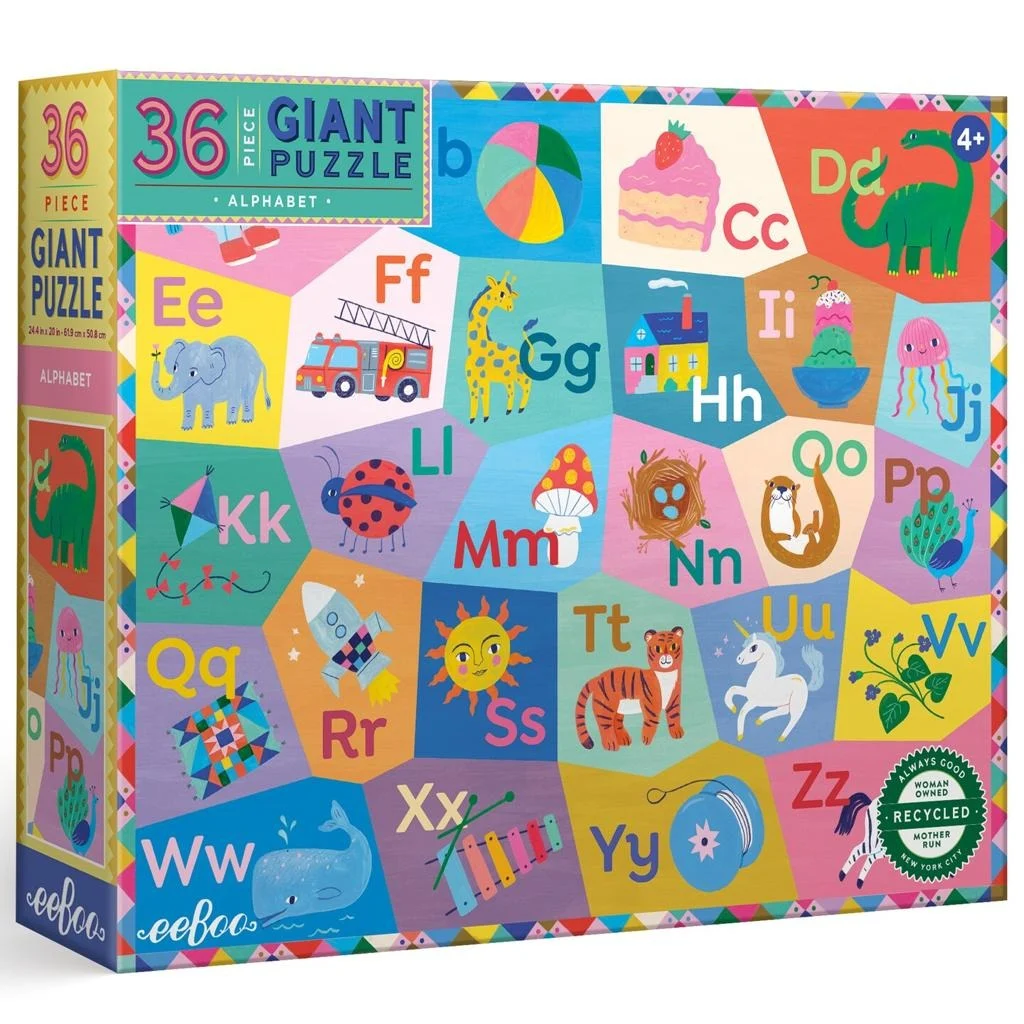
Educational puzzles can combine picture matching with conversations about letters, numbers, animals, nature, or everyday objects.
These products may be useful for parents and educators who want to make learning interactive. A puzzle featuring familiar objects, for example, gives adults opportunities to ask children to identify items, describe colors, or tell a story about the completed picture.
When selecting one, check that the educational theme fits the child’s current interests and learning stage. A puzzle should invite participation rather than feel like a test.
3. Children’s puzzles with more pieces
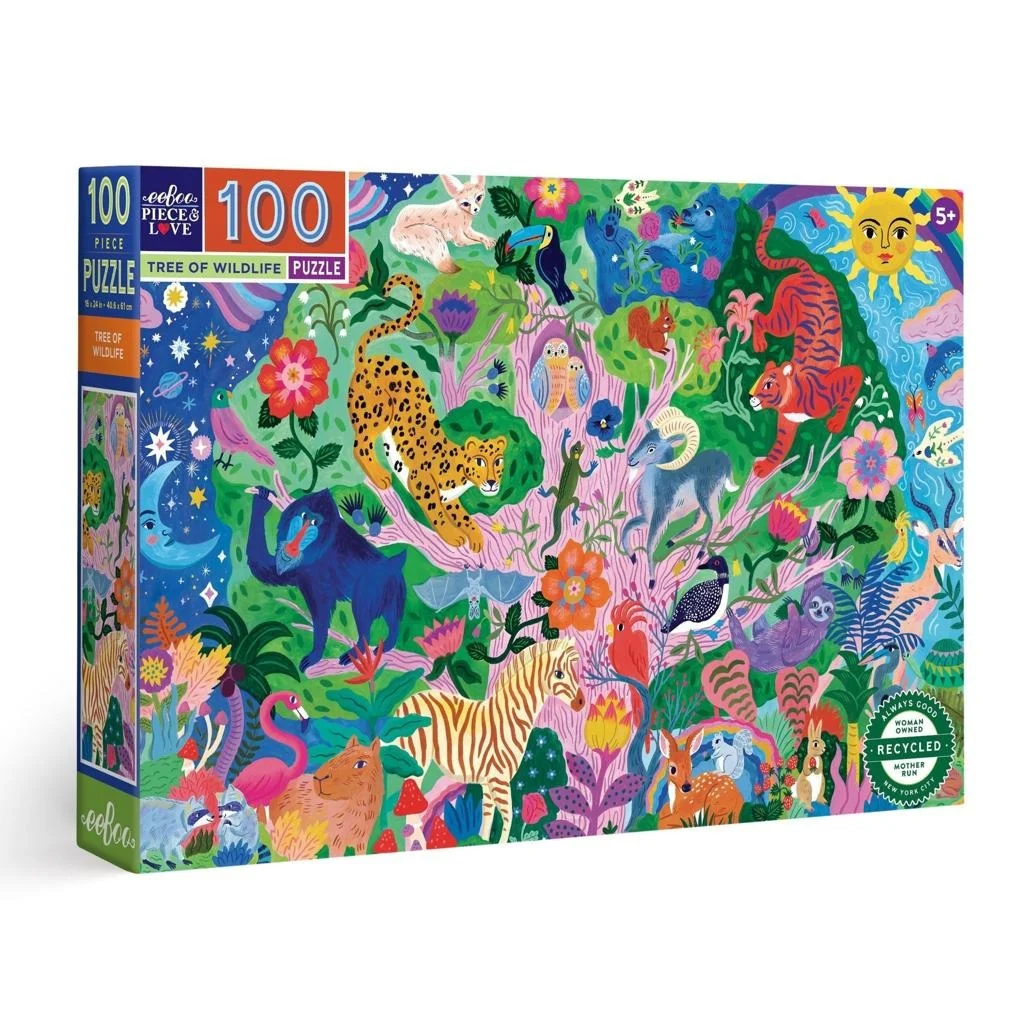
A larger children’s puzzle may suit a child who already enjoys completing smaller designs.
The increased piece count can make the activity more demanding, but piece count alone does not determine difficulty. Familiar pictures, strong color contrasts, and clearly separated objects may make a puzzle easier than a design with many similar-looking areas.
Consider a slightly more challenging puzzle when the child can complete the current one comfortably and still wants to continue.
4. Illustrated puzzles for families
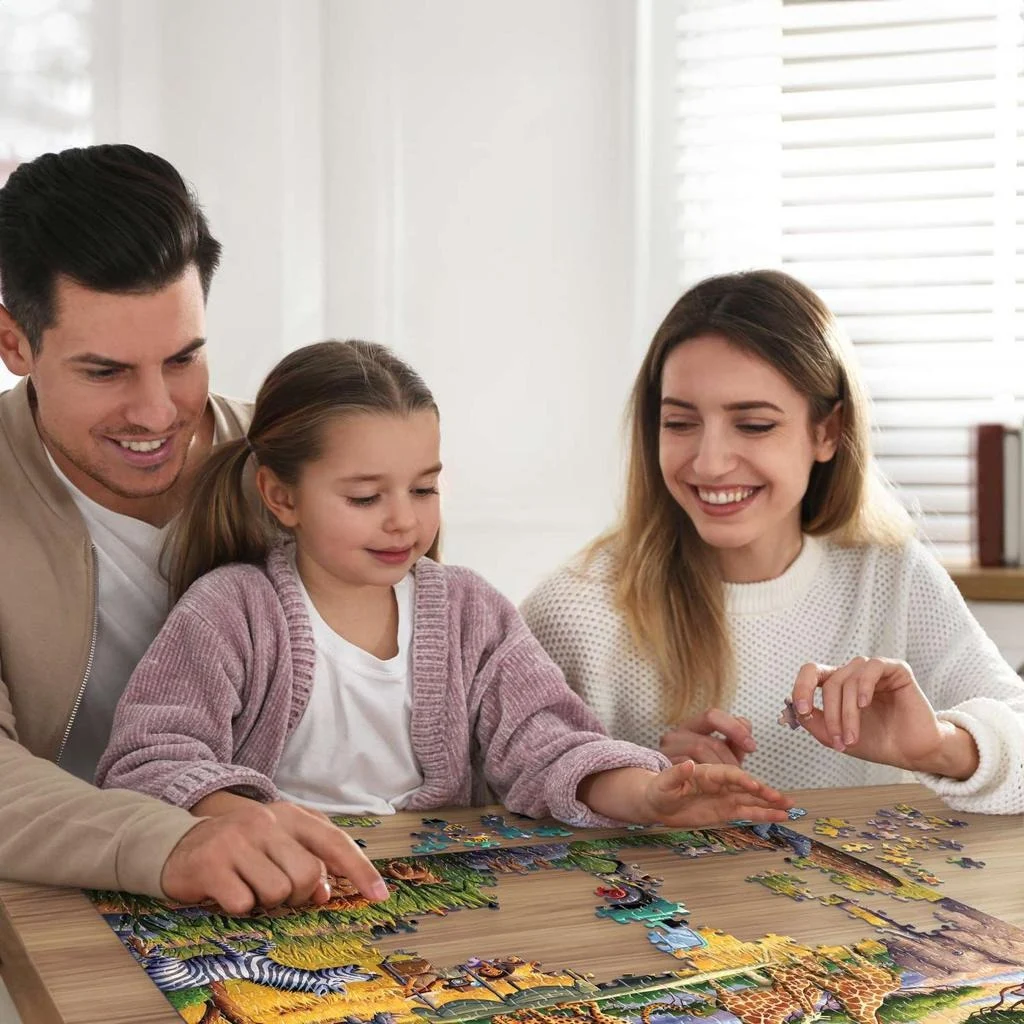
A family puzzle offers a shared activity in which different people can contribute at their own pace.
One person might sort edge pieces, another might group pieces by color, and someone else might work on a recognizable object in the illustration. This makes the activity accessible even when participants have different experience levels.
Choose a design that most participants will enjoy, and make sure you have enough table space to work comfortably.
5. Large-piece-count puzzles for adults and experienced puzzlers
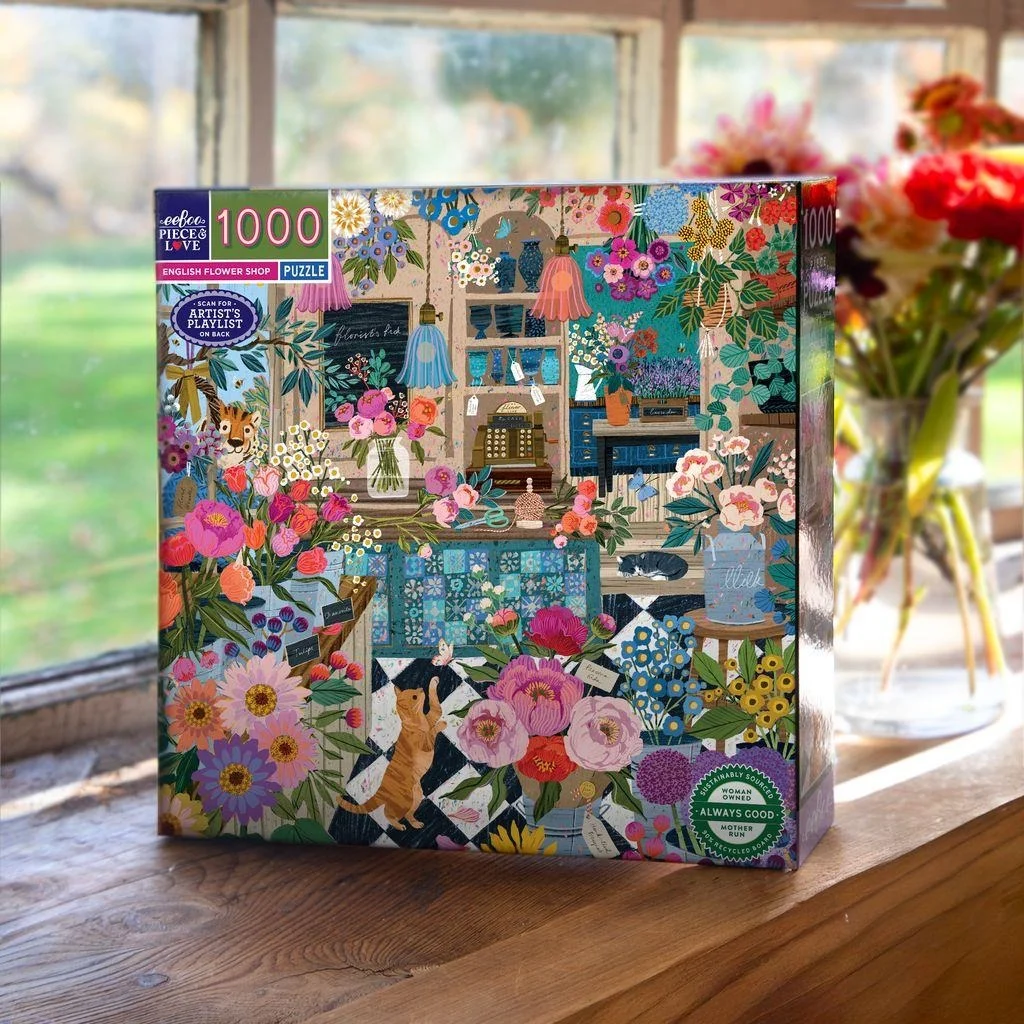
For people who enjoy extended jigsaw sessions, eeBoo’s Piece & Love collection includes 500- and 1,000-piece puzzles. The brand’s product pages feature illustrated scenes such as interiors, gardens, and imaginative settings.
eeBoo
These puzzles may appeal to experienced hobbyists, teens, and adults who want a longer project.
Before choosing one, consider:
- How much time the recipient wants to spend solving it.
- Whether the artwork contains distinct areas that are easy to sort.
- How much workspace the completed puzzle will require.
- Whether the person prefers relaxing scenes or more visually complex compositions.
A high piece count can create a satisfying challenge, but it isn’t automatically the best choice for every adult.
eeBoo Puzzle Piece Counts Explained
The number of pieces is one of the most visible ways to compare jigsaw puzzles. eeBoo’s official collections include multiple piece-count categories, from small children’s puzzles to large jigsaws.
| Piece count | A useful starting point | What to consider |
| 20 pieces | Young beginners, if age-approved | Simple matching and short sessions |
| 36–48 pieces | Children building confidence | More sorting and visual matching |
| 64–100 pieces | Children ready for more challenge | Picture complexity and patience |
| 500 pieces | Experienced children, teens, or adults as appropriate | Available time and visual detail |
| 1,000 pieces | Older teens and adults who enjoy longer projects | Workspace, complexity, and persistence |
These are broad selection guidelines, not official age assignments for every eeBoo product. Always check the exact product listing and packaging.
Is a 100-piece puzzle easier than a 500-piece puzzle?
Generally, yes, because fewer pieces usually mean fewer individual connections to make. However, a 100-piece puzzle with similar colors and repetitive patterns can still be challenging.
A useful rule is to compare both the piece count and the picture. Large, distinct objects are often easier to identify than subtle gradients, repeated patterns, or areas with similar colors.
Is a 1,000-piece puzzle suitable for beginners?
It can be, if the beginner wants a substantial challenge and is happy to work slowly. However, a smaller puzzle may offer a more encouraging first experience.
Beginners can build confidence by sorting edge pieces, grouping colors, and completing recognizable areas before tackling the most difficult sections.
How to Choose the Best eeBoo Puzzle for Kids
The right children’s puzzle should be engaging, age-appropriate, and challenging without becoming frustrating.
Check the recommended age first
Age recommendations are a useful starting point because they account for product design and safety considerations. They are not a guarantee that every child of that age will find the puzzle equally easy.
A child who enjoys puzzles regularly may be ready for a more challenging design, while another child of the same age may prefer fewer pieces.
Match the artwork to the child’s interests
A child who loves animals may be more motivated by a wildlife illustration than by a cityscape. Another may prefer space, maps, flowers, or imaginative scenes.
Interest matters because it encourages children to keep exploring the picture when a section becomes difficult.
Look for a manageable challenge
If a child can complete a puzzle independently with little effort, consider a modest increase in difficulty. If the child repeatedly becomes frustrated, try fewer pieces or artwork with clearer visual distinctions.
The goal is a satisfying activity, not the highest possible piece count.
Consider adult participation
Some children enjoy working independently, while others prefer completing puzzles with a parent, sibling, or teacher.
Choose a product that suits the way the child likes to play. A shared puzzle can also become an opportunity for conversation and cooperative problem-solving.
Are eeBoo Puzzles Educational?
Puzzles can support several learning-related activities, although the benefits depend on the puzzle, the child’s developmental stage, and how the activity is used.
Visual recognition and matching
Solvers compare colors, shapes, patterns, and picture details to determine where pieces belong. This encourages attention to visual information.
Problem-solving
A puzzler develops strategies, tests possible placements, and changes approach when a piece doesn’t fit.
Fine motor practice
Picking up, turning, and positioning puzzle pieces gives children opportunities to practice hand movements and coordination.
Language and conversation
Picture-based puzzles can encourage children to name objects, describe scenes, ask questions, and tell stories about the illustration.
Patience and persistence
A difficult section may take multiple attempts. Working through it can provide an opportunity to practice persistence without expecting every answer immediately.
Important distinction: These are potential benefits of puzzle activities in general, not a guarantee of measurable educational outcomes from every eeBoo product. If learning a specific skill is your priority, choose a puzzle whose visible content directly supports that goal.
What Makes eeBoo Puzzles Different?
When evaluating a branded puzzle, consider the qualities that are documented by the manufacturer and the features that matter to your own preferences.
Original illustrated artwork
eeBoo describes its products as featuring original artwork created in collaboration with artists. This is relevant to buyers who consider illustration a central part of the experience.
Options for different audiences
The brand’s collections cover both smaller-piece puzzles and large jigsaws, allowing shoppers to compare products for children and adults. The exact audience varies by product.
Material and sustainability information
eeBoo states that its jigsaw puzzles use recycled board, FSC-certified paper, and vegetable-based inks. These are manufacturer claims worth reviewing alongside the information provided for the particular product you intend to buy.
A broader range of puzzle-related products
The company’s catalog also includes educational games and other activities. If you are shopping for learning-oriented play rather than a traditional jigsaw, browsing the relevant category may help you compare alternatives.
These brand characteristics may help you decide whether eeBoo fits your preferences, but they do not mean every product will suit every shopper.
How to Buy eeBoo Puzzles Online
Start with the official eeBoo puzzle collection and compare the individual listings. The official website provides product names, images, piece counts, and prices for its listed puzzles.
Before purchasing, follow this checklist:
- Confirm the piece count. Make sure the product matches the level of challenge you want.
- Read the age recommendation. This is particularly important for children’s products.
- Inspect the full image. Check whether the artwork is likely to be enjoyable and manageable.
- Review the product details. Look for dimensions, included components, and other specifications.
- Check the current price. Prices and discounts may change.
- Confirm delivery options. Shipping availability and costs can vary by destination.
- Review the seller’s policies. Check returns, damaged-item procedures, and customer support before ordering.
If you’re purchasing from outside the United States, confirm international delivery, taxes, shipping fees, and the availability of a local retailer before placing an order.
Are eeBoo Puzzles Good Gifts?
A puzzle can be a thoughtful gift because it combines an attractive object with an activity the recipient can enjoy.
The best choice depends on the recipient’s interests and experience.
- For a young child: Choose an age-appropriate puzzle with a recognizable, appealing illustration.
- For a student: Consider a theme that connects with an existing interest or learning activity.
- For a family: Look for a puzzle that participants can work on together.
- For a teen: Match the piece count to their experience and willingness to spend time on the project.
- For an adult hobbyist: Explore the 500- and 1,000-piece options in the Piece & Love collection.
A useful gift-buying principle is to choose something the recipient will want to finish, not merely something that looks impressive on the box.
Tips for Solving a Jigsaw Puzzle More Efficiently
Even an appealing puzzle can be frustrating without a simple plan. These strategies can help beginners and experienced solvers alike.
1. Sort the edge pieces
Start by separating pieces with a straight outer edge. Assembling the border provides a visible boundary and helps establish the available workspace.
2. Group pieces by color or subject
Create small groups for recognizable objects, dominant colors, or distinct areas of the illustration. This reduces the number of pieces you need to consider at one time.
3. Use the reference picture
Keep the box image or included reference illustration nearby. Compare small details rather than relying on color alone.
4. Work on distinctive areas first
A bright object, building, animal, or flower may be easier to assemble than a section containing many similar shades.
5. Take breaks when needed
If the same pieces seem impossible to place, step away and return later. Fresh attention may make patterns easier to notice.
6. Protect the puzzle workspace
Choose a stable surface and keep pieces away from pets, very young children, food spills, and other sources of damage.
These techniques can improve the solving experience, but there is no single method that works best for every picture.
Common Mistakes to Avoid When Choosing a Puzzle
Choosing only by piece count: A larger puzzle is not necessarily more enjoyable. Artwork and individual experience matter too.
Ignoring age recommendations: Especially with young children, safety information should take priority over appearance.
Assuming every puzzle teaches the same skills: Choose educational themes intentionally instead of assuming that all puzzles provide identical learning opportunities.
Overlooking the finished dimensions: A larger jigsaw may need more workspace than expected.
Buying without checking the listing: Product names, prices, age guidance, availability, and included items can vary between products.
Expecting instant completion: Puzzle-solving is meant to involve discovery. Choose a difficulty that fits the recipient’s preferred pace.
Final Buying Checklist
Before selecting your eeBoo puzzle, make sure you can answer these questions:
- Does the product suit the intended solver’s age?
- Is the piece count appropriate for their experience?
- Will they enjoy the illustration or subject?
- Is the puzzle intended for independent or shared play?
- Have you checked the product dimensions and other specifications?
- Are the current price, delivery options, and seller policies acceptable?
If these details align with your needs, you’re much more likely to choose a puzzle that gets used and enjoyed.
FAQs
What are eeBoo puzzles?
eeBoo puzzles are illustrated jigsaw puzzles and related activity products sold by the eeBoo brand. The collection includes smaller puzzles for children and larger jigsaws for older puzzlers, with different themes and piece counts.
Are eeBoo puzzles suitable for toddlers?
Some eeBoo products are designed for very young children, but suitability depends on the specific product. Check the manufacturer’s minimum age, piece dimensions, and safety warnings before purchasing. Avoid puzzles containing small pieces that could pose a choking hazard.
What piece counts are available for eeBoo puzzles?
The official collection includes categories such as 20, 36, 48, 64, 100, 500, and 1,000 pieces. Availability and individual product specifications may change, so check the current listing before ordering.
Are eeBoo puzzles good for adults?
Yes, the brand offers larger jigsaw puzzles through its Piece & Love collection, including 500- and 1,000-piece formats. These may appeal to adults who enjoy illustrated artwork and longer puzzle-solving sessions.
Are eeBoo puzzles educational?
Puzzles can encourage visual matching, problem-solving, fine motor practice, and conversation. Educational value varies by design, so choose a puzzle with a theme or activity that matches the learning goal.
Are eeBoo puzzles made with sustainable materials?
eeBoo states that its jigsaw puzzles use recycled board, FSC-certified paper, and vegetable-based inks. Review the manufacturer’s current product and sustainability information for further details.
Where can I buy eeBoo puzzles?
You can browse the official eeBoo puzzle collection. Other retailers may carry selected products, but availability, prices, delivery charges, and return policies vary.
How do I choose the right eeBoo puzzle?
Start with the recommended age and piece count, then consider the illustration, the solver’s experience, and the available workspace. For children, prioritize safety and a manageable challenge. For experienced adults, compare larger puzzles and more detailed artwork.
Are eeBoo puzzles good gifts?
They can be a good gift for someone who enjoys illustrated artwork, quiet activities, or jigsaw challenges. Match the piece count and theme to the recipient’s interests instead of assuming that a more difficult puzzle is always better.
What is the difference between eeBoo children’s puzzles and Piece & Love puzzles?
The collections serve different puzzle-shopping needs. The wider eeBoo range includes smaller-piece options, while Piece & Love features 500- and 1,000-piece jigsaws aimed at older audiences. Always verify the intended audience for an individual product.
Conclusion
eeBoo puzzles offer options for shoppers looking for illustrated jigsaws, children’s activities, and more challenging puzzles for older audiences. The brand’s range includes multiple piece counts, while its Piece & Love collection features larger puzzles for people who enjoy extended solving sessions.
The best choice isn’t necessarily the biggest or most complicated puzzle. Start with the recipient’s age, interests, experience, and available workspace, then compare the details of individual products before buying. For your next step, explore the official eeBoo puzzle collection and shortlist a few designs that fit your needs.
A well-chosen puzzle can provide a satisfying challenge, an opportunity to share time with others, and a finished picture worth enjoying.

Mason Reed is a puzzle writer and enthusiast at Puzzlenexa.com, where he creates engaging puzzles, brain teasers, riddles and problem-solving challenges. His goal is to make every puzzle enjoyable, thought-provoking and rewarding for readers of all ages.