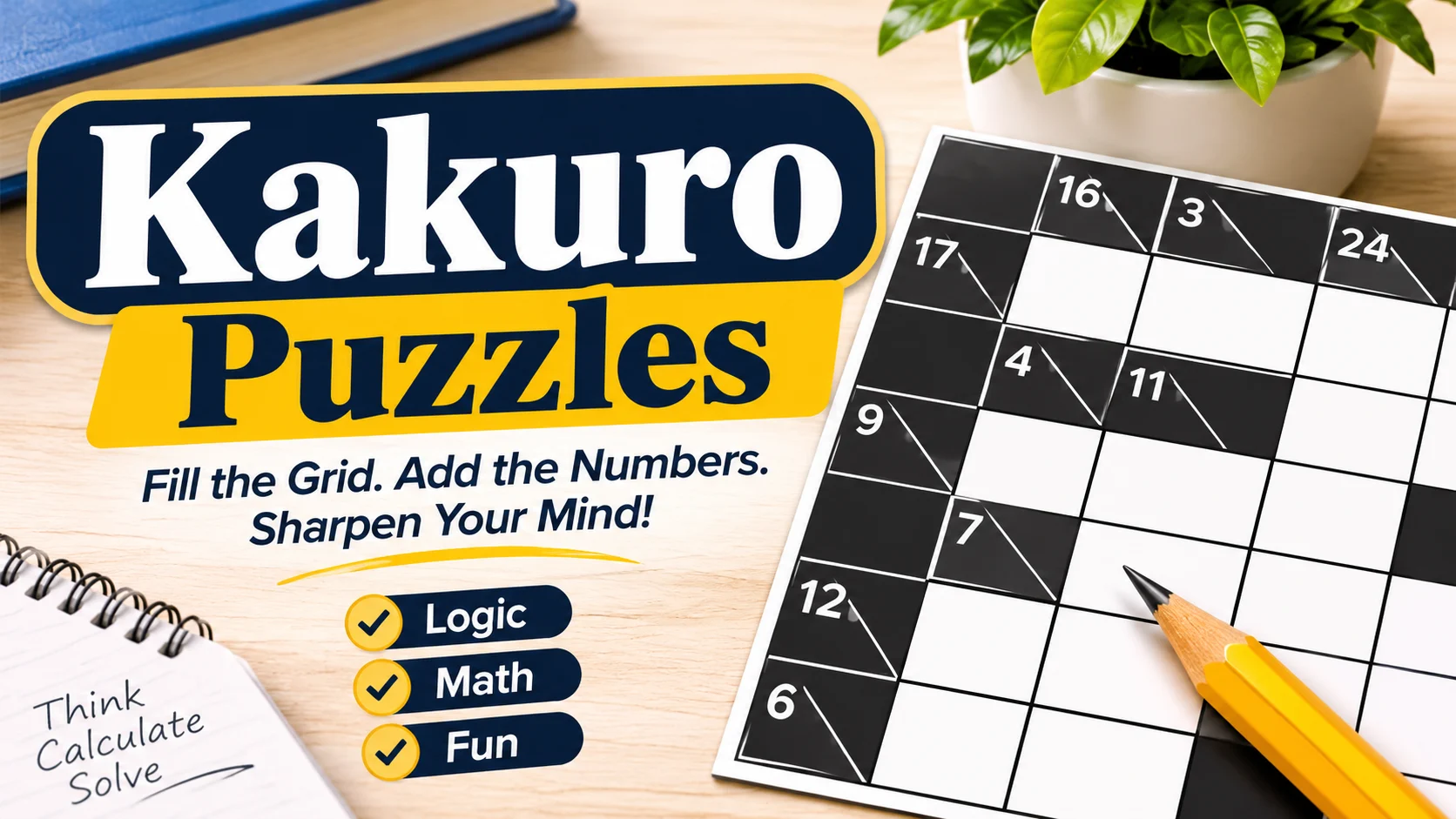
Kakuro puzzles are number-crossword games in which you fill white cells with digits from 1 to 9. Each horizontal or vertical run must add up to its clue, and digits cannot repeat within the same run. Solve Kakuro by finding possible digit combinations and using crossing clues to determine their correct positions.
If you enjoy number puzzles that combine arithmetic with logical deduction, Kakuro is an excellent challenge. Often called a cross-sum puzzle, Kakuro resembles a crossword, but instead of filling in words, you complete a grid of numbers using sum clues.
The rules are straightforward, yet even a small grid can require careful reasoning. You must find digit combinations that match each clue, avoid repeating digits within a run, and make sure every cell satisfies both its horizontal and vertical conditions.
This guide explains how to play Kakuro puzzles, introduces practical strategies for beginners, and provides original mini-puzzles with hints and answers. Start with the easy challenges, then try the more demanding combinations. You can also use the answer keys to check your work and learn how the deductions fit together.
What Is a Kakuro Puzzle?
A Kakuro puzzle is a number-placement puzzle built around sums. Black cells contain clues, while white cells are filled with digits from 1 to 9.
Each uninterrupted sequence of white cells is called a run. A run may go horizontally or vertically, and every run must satisfy two conditions:
- Its digits add up to the associated clue.
- No digit appears more than once within that run.
For example, a two-cell run with a clue of 4 must contain 1 and 3. The combination 2 and 2 is invalid because repeating a digit within the run is not allowed.
How to Play Kakuro Puzzles
Step 1: Understand the clue cells
Kakuro clue cells are commonly divided diagonally. One number gives the sum of the white cells extending to the right; the other gives the sum of the white cells below. The exact visual convention should be clear from the puzzle’s instructions.
Step 2: Fill the white cells
Use only the digits 1 through 9. Zero is never a valid entry.
Step 3: Match each clue
Add the digits in each horizontal and vertical run. The total must equal the clue exactly.
Step 4: Avoid repeated digits
A digit cannot repeat within one uninterrupted run. However, the same digit may appear elsewhere in the grid, including in a different run.
Step 5: Use intersecting runs
Every white cell belongs to a horizontal run and a vertical run. The correct digit must satisfy both sums and both no-repeat restrictions.
Kakuro Rules at a Glance
| Rule | Example |
| Use digits 1–9 | 0 is not allowed |
| Match the clue sum | 1 + 3 = 4 |
| Do not repeat within a run | 2 + 2 is invalid |
| Check horizontal and vertical runs | Every cell must satisfy both |
| Use deduction to narrow choices | Eliminate combinations that conflict with crossing clues |
Essential Kakuro Number Combinations
Some clue-and-length combinations have only one possible set of digits. These are excellent starting points because they immediately tell you which digits must appear in a run, even if their order is not yet known.
| Number of cells | Sum | Required digits |
| 2 | 3 | 1, 2 |
| 2 | 4 | 1, 3 |
| 2 | 16 | 7, 9 |
| 2 | 17 | 8, 9 |
| 3 | 6 | 1, 2, 3 |
| 3 | 7 | 1, 2, 4 |
| 3 | 23 | 6, 8, 9 |
| 3 | 24 | 7, 8, 9 |
| 4 | 10 | 1, 2, 3, 4 |
| 4 | 30 | 6, 7, 8, 9 |
These are digit sets, not necessarily the final left-to-right or top-to-bottom order.
Why the smallest and largest sums matter
A two-cell sum of 3 can only be made with 1 and 2. A two-cell sum of 17 can only be made with 8 and 9. Similarly, the smallest possible sum for three distinct digits is 1+2+3=61+2+3=6, and the largest is 7+8+9=247+8+9=24.
Recognizing these limits helps you identify impossible clues and forced combinations quickly.
Strategies for Solving Kakuro Puzzles
1. Begin with forced combinations
Look for runs whose clue and length permit only one set of digits. Record the possible digits, then use crossing clues to determine their positions.
2. Use candidate lists
For a run with several possible combinations, jot down the available digits in each cell. Cross out candidates whenever they violate another clue.
3. Solve intersections
Suppose a cell belongs to a horizontal run that allows 1, 3, or 5, while its vertical run allows 2, 3, or 8. The only shared candidate is 3, so that cell must contain 3.
4. Check the remaining total
If a run has a clue of 16 and two cells already contain 7 and 5, the final cell must be 4. Confirm that 4 does not duplicate another digit in the same run.
5. Work from constraints, not guesses
A candidate is valid only if it satisfies every relevant rule. If an entry produces a repeated digit or an impossible sum, revisit the last deduction rather than forcing the rest of the grid to fit.
6. Verify the completed grid
When finished, add every horizontal and vertical run independently. Confirm that each clue matches and no run contains repeated digits.
3 Original Kakuro Puzzles With Answers
These mini-puzzles use a compact format so you can solve them on screen or copy them onto paper. All three are original practice grids with two horizontal runs and two vertical runs.
How to read the grids: The horizontal clues are listed beside each row. The vertical clues appear above each column. Fill the four white cells using digits 1–9 without repeating a digit within any row or column.
Puzzle 1 The Starter Grid
Easy
Vertical clues: 8 and 12
DOWN
8
DOWN
12
ACROSS
4
ACROSS
?
?
16
ACROSS
?
?
Complete both horizontal sums and both vertical sums.
Hint: The two-cell run totaling 4 must use the digits 1 and 3. The run totaling 16 must use 7 and 9.
Reveal answer and explanation
Puzzle 2 The Seven Challenge
Medium
Vertical clues: 9 and 15
DOWN
9
DOWN
15
ACROSS
7
ACROSS
?
?
17
ACROSS
?
?
Hint: A two-cell run totaling 17 must contain 8 and 9. Use the vertical totals to determine their order and then identify the first row.
Reveal answer and explanation
Puzzle 3 The Cross-Sum Test
Hard
Vertical clues: 9 and 11
DOWN
9
DOWN
11
ACROSS
3
ACROSS
?
?
17
ACROSS
?
?
Hint: The top row must contain 1 and 2. The bottom row must contain 8 and 9. The column clues determine which digit goes in each position.
Reveal answer and explanation
Where to Find More Kakuro Puzzles
If you want to continue practicing after these mini-grids, these resources offer additional formats:
- Kakuro Game How to Play : rules, example solving steps, and practical hints.
Kakuro Game - Online Kakuro Combinations : reference tables for valid digit combinations.
Online Kakuro - Printable Kakuro Print Puzzles : printable grids and answer keys in different sizes and difficulty levels. Check the site’s current access and printing terms.
FAQs
What are Kakuro puzzles?
Kakuro puzzles are number-crossword games in which digits from 1 to 9 must add up to the sums shown in horizontal and vertical clue cells. Each uninterrupted run must contain distinct digits. Solving involves arithmetic, recognizing valid combinations, and using intersecting clues to determine the correct entries.
How do you solve Kakuro puzzles for beginners?
Start with short runs whose sums have only one possible digit combination. For example, two cells totaling 3 must contain 1 and 2. Then use the crossing runs to establish the order, eliminate impossible digits, and verify every completed sum.
What is the difference between Kakuro and Sudoku?
Kakuro uses arithmetic clues that specify the sums of consecutive cells, with no repeated digits within a run. Sudoku uses row, column, and box restrictions to place digits. Both require logical deduction, but Kakuro relies more directly on addition and combinations.
Can you repeat numbers in Kakuro?
No. A digit cannot appear twice within the same uninterrupted horizontal or vertical run. However, a digit may appear elsewhere in the grid or in another run. Each entry must satisfy both crossing clues without creating a repeated digit in either run.
What is the easiest Kakuro combination to remember?
For two cells, a sum of 3 must be 1 and 2, while a sum of 17 must be 8 and 9. For three cells, a sum of 6 must be 1, 2, and 3. These combinations are useful starting points when solving a grid.
Are Kakuro puzzles good for beginners?
Yes. Small grids introduce the rules without overwhelming you with too many intersections. Start with short runs and straightforward sums, then progress to longer grids with several possible combinations. Using hints and checking solutions can help you understand the deduction process.
Can I print Kakuro puzzles with answers?
Yes. Some puzzle websites provide printable Kakuro grids and separate solution sheets. Check the available formats and printing permissions before downloading. You can also copy the mini-grids in this guide onto paper and use the answer sections to check your completed work.
Do Kakuro puzzles require advanced mathematics?
No. Basic addition is sufficient. The main challenge is identifying which distinct digits can produce each sum and determining their positions from intersecting clues. Candidate lists and a little systematic elimination are usually more valuable than fast mental arithmetic.
Conclusion
Kakuro puzzles are a rewarding way to practice arithmetic, deduction, and careful observation. Once you understand the sum clues and the rule against repeated digits within a run, you can start identifying forced combinations and using crossing entries to solve more difficult grids.
Work through the three practice puzzles again without looking at the answers, or print the grids for an offline challenge. When you’re ready to progress, explore longer Kakuro grids and combination tables to develop your solving technique. You can also challenge a friend to complete the same grid and compare the deductions you used to reach the solution.

Ryan Mitchell is a writer and puzzlesmith who crafts engaging brainteasers, logic puzzles and interactive word games for Puzzlenexa.com. With a deep passion for problem solving, his work focuses on challenging readers, encouraging critical thinking and making complex puzzles accessible and fun for all skill levels.