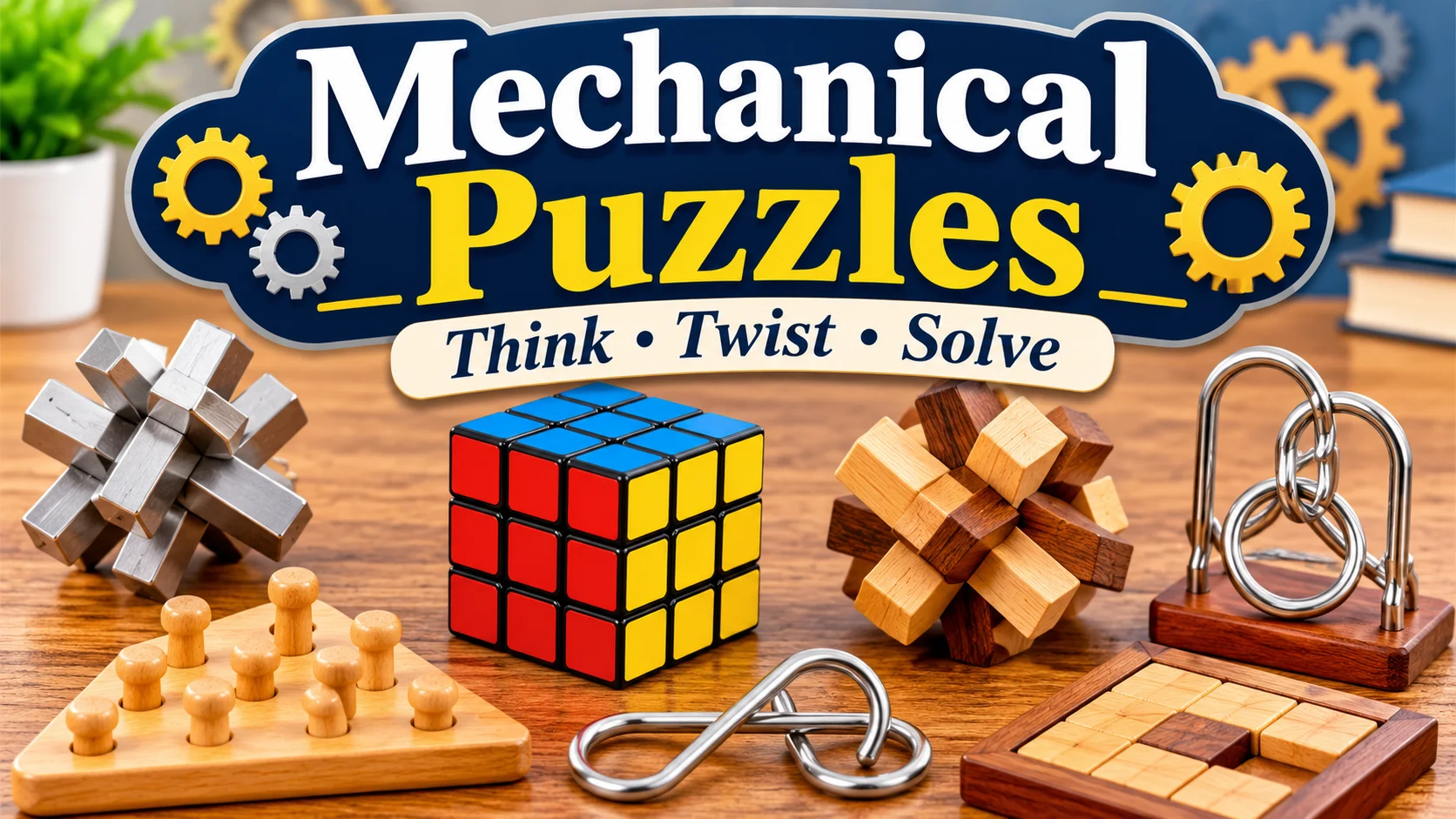
Mechanical puzzles are physical brain teasers that require you to manipulate objects, move components, assemble pieces, separate linked parts, or discover a hidden mechanism to reach a specific goal. Common types include wooden interlocking puzzles, metal disentanglement puzzles, sequential movement puzzles, puzzle boxes, and dexterity challenges.
Mechanical puzzles are hands on challenges in which the solution depends on understanding how an object or its components can move. Unlike a conventional riddle, which is usually solved through language and reasoning alone, a mechanical puzzle involves a physical object or a simulated mechanism with rules and constraints.
Some puzzles require you to take an object apart. Others ask you to reconstruct it, move pieces in a particular order, free a trapped ring, or open a container without damaging it.
The challenge is not necessarily strength or speed. Often, the important discovery is realizing which movement is possible, which component is blocking another, or which sequence of actions leads to the goal.
Mechanical puzzles range from simple children’s toys to intricate designs that challenge experienced adult solvers. They can be made from wood, metal, plastic, cord, or combinations of materials.
What Are the Main Types of Mechanical Puzzles?
The most useful way to classify a mechanical puzzle is by the task you must complete. Established classifications distinguish several major families, although some puzzles combine more than one mechanism.
1. Interlocking puzzles
Spatial reasoning
Multiple pieces fit together and lock into a stable structure. The solver must discover how the pieces can be separated and often how to reconstruct the original shape.
Example: A wooden burr puzzle made from notched bars.
Best for: People who enjoy three dimensional problem solving.
2. Disentanglement puzzles
Movement and deduction
The objective is to free a ring, loop, cord, or other component without bending or breaking the pieces.
Example: A metal wire puzzle with two linked loops.
Best for: Solvers who like testing possible paths and eliminating impossible movements.
3. Puzzle boxes
Discovery
A puzzle box hides its opening method behind sliding panels, concealed catches, movable parts, or a specific sequence of actions.
Example: A wooden box that opens only after a particular panel is moved.
Best for: People who enjoy uncovering hidden mechanisms.
4. Sequential movement puzzles
Planning
Each move changes the available options. The solver must find a sequence that transforms the starting arrangement into a target state.
Example: A Rubik’s Cube or the Tower of Hanoi.
Best for: Pattern recognition, planning, and systematic experimentation.
5. Assembly and packing puzzles
Spatial visualization
Separate pieces must fit into a defined shape, frame, or container. Some designs interlock; others simply fit together.
Example: A collection of wooden pieces that must form a cube.
Best for: Solvers who enjoy visualizing shapes and testing arrangements.
6. Dexterity puzzles
Fine motor control
These puzzles require controlled physical movements, balancing, guiding, or manipulating a component through obstacles. Some combine dexterity with logical deduction.
Example: A handheld wire maze that requires a small object to pass through a prescribed route.
Best for: Solvers who enjoy precise physical control as well as reasoning.
These six families cover many familiar mechanical puzzles, but they are not an exhaustive classification. Folding puzzles, puzzle vessels, vanishing puzzles, and impossible objects are other recognized categories.
How to Solve Mechanical Puzzles
The best solving strategy depends on the mechanism, but a few habits work across many puzzle types.
Step 1: Understand the goal
Decide exactly what success means. Do you need to open a box, remove a ring, separate wooden pieces, or assemble a target shape?
Step 2: Inspect the components
Look for slots, notches, gaps, sliding panels, joints, and pieces that appear to move independently. Observe before applying force.
Step 3: Change one thing at a time
Try a small movement, observe what changes, and return to the previous position if it fails. Changing several components simultaneously makes it harder to learn the mechanical puzzle.
Step 4: Record useful moves
Note which moves create new space or release a previously blocked component. This is especially helpful for puzzles with long movement sequences.
Step 5: Learn the reverse sequence
If you take a puzzle apart, pay attention to the order of removal. Reversing the sequence is often a useful starting point for reassembly.
Important: Never force a component that appears firmly blocked. Some mechanisms require a precise alignment or sequence, and excessive force can damage the puzzle.
Mechanical Puzzle Challenges: Can You Solve These?
The following are original, text based mechanical reasoning exercises. They simulate simplified physical mechanisms so you can practice planning and deduction without needing a physical puzzle. They are not solutions to particular commercial puzzle models.
Puzzle 1 The Sliding Gate
Easy
Question: A gate is blocked by a sliding bar. The bar can move either left or right, but the gate opens only when the bar’s central notch lines up with a fixed peg. Moving the bar left takes the notch farther from the peg. Moving it right brings the notch closer.
Which direction should you try first?
Left
Right
Push the gate harder
Answer: Move the bar right.
Why: The description specifies which movement approaches the required alignment. This is a simple example of using a mechanism’s constraints instead of relying on force.
Puzzle 2 The Trapped Ring
Easy Medium
Question: A ring is threaded onto a rigid wire path. It can move freely along the wire but cannot pass through solid metal. The wire has one open end and one closed loop. The ring must leave through the open end.
What general strategy should you follow?
Bend the wire until the ring fits through
Trace the ring’s path toward the open end, reversing around obstacles as needed
Pull the ring straight through the closed loop
Answer: Trace the permitted route toward the open end.
Why: A rigid disentanglement puzzle must be solved through allowed movements. The exact route depends on the wire’s geometry, but bending or passing through solid metal is not permitted.
Puzzle 3 The Three-Disc Tower
Medium
Question: Three discs of different sizes are stacked on the first of three pegs, largest at the bottom. Your goal is to move the entire stack to the third peg.
Rules:
- Move only one disc at a time.
- Never place a larger disc on a smaller disc.
- You may use the middle peg.
What is the minimum number of moves?
5 moves
7 moves
9 moves
Answer: 7 moves.
Why: First move the two smaller discs to the middle peg in three moves. Move the largest disc to the destination peg in one move. Then transfer the two smaller discs onto it in three more moves. The total is 3+1+3=7.
Puzzle 4 The Hidden Compartment
Medium
Question: A puzzle box has three movable panels. The instructions say that one panel must be fully slid before another panel can move. You notice that panel A stops halfway, while panels B and C remain locked.
What should you investigate first?
Force panels B and C open
Inspect panel A for a stop, alignment, or hidden travel path
Shake the box until the panels release
Answer: Inspect panel A’s movement and alignment.
Why: The available information suggests that panel A’s incomplete movement may be preventing the other panels from releasing. This is a reasoning exercise, not a claim about the mechanism of a specific puzzle box.
What Makes Mechanical Puzzles Difficult?
Mechanical puzzles become challenging for different reasons.
- Hidden constraints: A piece may appear free to move but be blocked by another component.
- Sequential dependencies: One move must happen before another becomes possible.
- Spatial complexity: Several pieces occupy the same three dimensional space.
- Misleading symmetry: Two sides may look similar but behave differently.
- Reassembly: A puzzle may be easier to take apart than to put back together.
A difficult puzzle does not necessarily have many pieces. A compact mechanism with one hidden dependency can be harder than a larger puzzle with obvious movement rules.
How to Choose the Right Mechanical Puzzle
The best mechanical puzzle depends on your experience, preferred solving style, and patience.
| If you enjoy… | Consider… | Why |
| Building shapes | Wooden assembly puzzles | They emphasize spatial arrangement. |
| Exploring hidden movement | Metal disentanglement puzzles | They reward controlled experimentation. |
| Discovering secret mechanisms | Puzzle boxes | They encourage observation and sequential reasoning. |
| Planning ahead | Sequential movement puzzles | The order of moves determines success. |
| Physical precision | Dexterity puzzles | They combine reasoning with controlled movement. |
| A challenge for the whole family | Beginner friendly interlocking puzzles | Simple designs let several people compare approaches. |
Beginner, intermediate, or advanced?
Beginners: Choose a puzzle with a clearly defined objective, few components, and a manageable solution sequence.
Intermediate solvers: Try interlocking puzzles with a hidden key piece, metal disentanglement challenges, or puzzle boxes with multiple stages.
Advanced solvers: Explore intricate burr constructions, longer sequential movement puzzles, and designs that require careful documentation of intermediate states.
Difficulty labels are not standardized across all manufacturers. A puzzle rated difficult by one seller may feel manageable to someone experienced with that particular mechanism.
Are Mechanical Puzzles Good for the Brain?
Mechanical puzzles provide opportunities to practice spatial visualization, planning, experimentation, and systematic problem solving. The exact skills involved depend on the puzzle: an interlocking puzzle emphasizes spatial relationships, while a sequential movement puzzle places more emphasis on move order and planning.
They can also encourage persistence and careful observation. However, enjoying these puzzles does not guarantee broad improvements in intelligence or performance in unrelated tasks. Their most direct value is the thinking and problem solving involved in the activity itself.
FAQs
What is a mechanical puzzle?
A mechanical puzzle is a physical object or arrangement of movable components that must be manipulated to achieve a specific goal. The task might involve assembling pieces, separating linked parts, opening a concealed compartment, or moving components into a target configuration.
What are the main types of mechanical puzzles?
Common types include interlocking puzzles, assembly puzzles, disentanglement puzzles, sequential movement puzzles, puzzle boxes, and dexterity puzzles. Other recognized categories include folding puzzles, puzzle vessels, vanish puzzles, and impossible objects. Categories can overlap when a puzzle combines multiple mechanisms.
Are mechanical puzzles suitable for beginners?
Yes. Beginners can start with simple assembly puzzles, basic wire disentanglement challenges, or small sliding puzzles. Choose a design with a clear objective and manageable difficulty, then progress to more intricate mechanisms as you become comfortable observing and testing possible movements.
How do you solve a mechanical puzzle?
Start by identifying the goal and examining how the pieces fit together. Test small, permitted movements, observe which components become free, and record useful sequences. Avoid forcing blocked pieces. If you successfully disassemble a puzzle, study the order of removal to help reconstruct it.
What is a burr puzzle?
A burr puzzle is an interlocking mechanical puzzle commonly constructed from notched bars or pieces that fit together into a three dimensional structure. The solver must discover how the components can separate and often how to reassemble them. Some designs have a key piece that controls the release of the others.
What is a disentanglement puzzle?
A disentanglement puzzle challenges you to separate linked components, such as metal rings, wire loops, or cord sections, without bending or breaking the parts. The solution depends on following a valid path through the mechanism rather than pulling harder or forcing the components apart.
Are puzzle boxes mechanical puzzles?
Yes. Many puzzle boxes use sliding panels, concealed catches, movable parts, or sequential actions to prevent immediate opening. The solver must discover the correct mechanism or movement order. Some boxes also incorporate clues or multiple stages, combining mechanical reasoning with observation and deduction.
Are mechanical puzzles good for adults?
Mechanical puzzles can provide adults with engaging challenges involving spatial reasoning, planning, experimentation, and persistence. They range from approachable handheld puzzles to complex interlocking constructions and multi stage boxes. The best choice depends on your preferred solving style rather than age alone.
Can mechanical puzzles be solved without instructions?
Many mechanical puzzles are designed to be solved through observation and experimentation without detailed instructions. However, some designs include essential rules or safety considerations. If instructions are supplied, read them first to understand the objective, permitted movements, and any restrictions on manipulating the components.
How do I choose a mechanical puzzle as a gift?
Consider the recipient’s experience, preferred materials, patience, and interest in spatial or sequential challenges. A simple wooden assembly puzzle suits many beginners, while experienced enthusiasts may prefer intricate burr puzzles, metal disentanglement designs, or multi stage puzzle boxes. Difficulty descriptions vary, so check the actual mechanism before choosing.
Conclusion
Mechanical puzzles offer a hands on way to explore logic, movement, construction, and spatial reasoning. From simple wooden assemblies to intricate disentanglement puzzles and hidden opening boxes, each type presents a different challenge. Start by understanding the objective, examining the components, and testing one permitted movement at a time. When you solve a puzzle, study the sequence that worked so you can repeat or reverse it if necessary. If you want to keep improving, try a different puzzle family rather than simply choosing a more complicated version of the same design. Comparing mechanisms is one of the most rewarding ways to discover how mechanical puzzles work.

Ryan Mitchell is a writer and puzzlesmith who crafts engaging brainteasers, logic puzzles and interactive word games for Puzzlenexa.com. With a deep passion for problem solving, his work focuses on challenging readers, encouraging critical thinking and making complex puzzles accessible and fun for all skill levels.