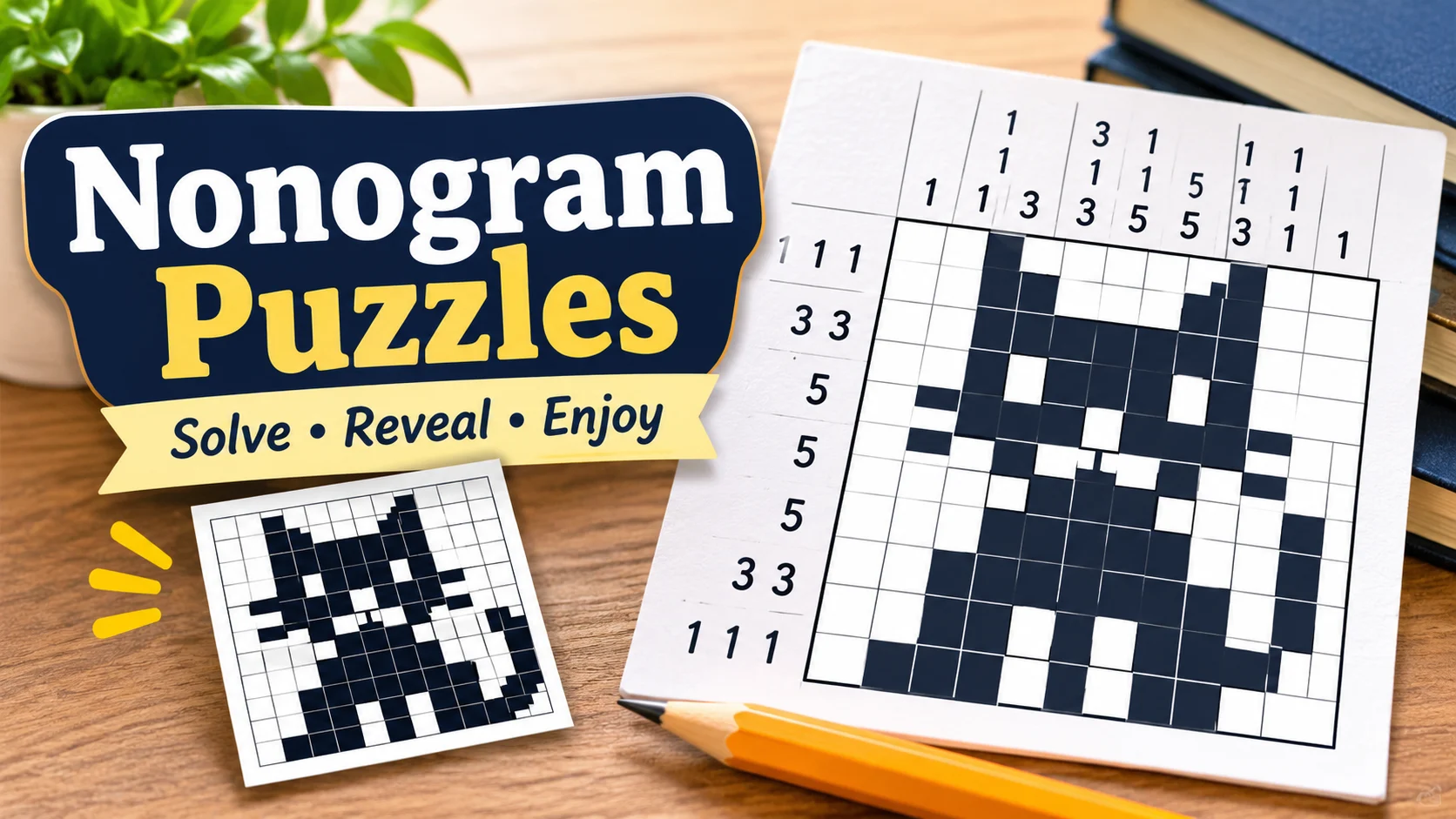
Nonogram puzzles are picture logic games in which you fill selected squares in a grid using number clues along each row and column. Each number represents a consecutive group of filled cells. By combining the clues and marking cells that must remain empty, you gradually reveal a hidden picture without relying on guesses.
A nonogram is a grid based logic puzzle that reveals a picture when its clues are solved correctly. You may also see these puzzles called Picross, Griddlers, Hanjie, or picture logic puzzles. The names can vary by game or publication, but the familiar format uses number clues to determine which cells to fill.
beginner rules and a 5×5 example+2
Unlike a traditional crossword, a nonogram does not ask you to write words. Instead, you use numerical clues to identify groups of filled squares. The completed pattern might resemble a heart, animal, flower, object, or simple piece of pixel art.
Nonograms are especially appealing to people who enjoy careful observation, deduction, and solving a picture one logical step at a time.
How to Play Nonogram Puzzles
The rules are straightforward once you understand what the numbers mean.
1. Read the row clues
Numbers to the left of the grid describe groups of filled cells from left to right.
For example, a clue of 3, 1 means:
- Three filled cells together.
- At least one empty cell.
- One more filled cell after the gap.
The clue gives the group sizes and their order, but it may not tell you the exact positions immediately.
2. Read the column clues
Numbers above the grid work in the same way, but they are read from top to bottom.
Every cell belongs to both a row and a column. That is the key to solving the puzzle: a deduction in one row can help you work out the correct cells in several columns.
3. Separate filled and empty cells
Use a filled square such as ■ for a confirmed picture cell and × for a confirmed empty cell. Leave uncertain cells blank.
Marking empty cells is useful because it rules out placements that would otherwise seem possible.
4. Keep groups in order
If a line has the clue 2, 1, 2, it must contain a group of two filled cells, then a group of one, then a group of two. Each pair of groups must have at least one empty cell between them.
You can leave more than one empty cell between groups when the other clues permit it.
Nonogram Solving Techniques for Beginners
Start with clues that fill a whole line
If a row contains five cells and its clue is 5, fill all five cells. There is only one possible arrangement.
Likewise, a line with a clue of 0 contains no filled cells. Some games show this as a zero; others leave the clue area blank.
Use the overlap method
Suppose a row has five cells and the clue is 4. The four cell group could start at the left or right edge:
Possible placements for clue 4
Placed as far left as possible
■
■
■
■
·
Placed as far right as possible
·
■
■
■
■
The three middle cells are filled in both placements, so those three cells are guaranteed to be filled.
This is called the overlap technique. Imagine placing a group as far to one side as possible and then as far to the other side. Any cell occupied in both extreme placements must be filled.
Switch between rows and columns
After filling a confirmed cell, check its column. After marking an empty cell, check its row. Each new fact can reduce the possible placements in crossing lines.
Avoid guessing too early
If you feel stuck, revisit the clues and ask what they rule out. Look for long groups, forced gaps, edge placements, and rows or columns that are almost complete. A well designed logic puzzle should provide a defensible route to its solution.
Try This Easy 5×5 Nonogram Puzzle
Difficulty: Easy · Goal: Reveal a simple picture using row and column clues.
Solve the grid using the clues below. Each row clue is shown on the left, and each column clue is shown above. The grid is blank so you can work out the answer yourself.
Column clues
2
4
5
4
2
3
5
5
3
1
Tap a cell to cycle through filled, empty (×), and unknown. Your marks are for practice; they are not automatically graded.
Show hintReveal answerReset grid
Check the answer
The completed pattern is:
·
■
■
■
·
■
■
■
■
■
■
■
■
■
■
·
■
■
■
·
·
·
■
·
·
Why it works: The middle column’s clue of 5 fills all five cells. The second and fourth columns each have a clue of 4, while the outer columns each have a clue of 2. Together, the row and column clues determine the displayed pattern.
Common Nonogram Mistakes to Avoid
- Ignoring the gap rule: Separate groups require at least one empty cell.
- Reading clues in the wrong direction: Row clues run left to right; column clues run top to bottom.
- Filling cells based on the picture you expect: The clues, not your guess about the hidden image, determine the answer.
- Leaving known empty cells unmarked: Crosses help prevent invalid placements.
- Solving rows without checking columns: The clues work together, so revisit crossing lines after each deduction.
How to Get Better at Nonogram Puzzles
Start with 5×5 grids until the clue rules become familiar. Then move to 10×10 puzzles and gradually try larger boards.
For steady progress:
- Solve full or nearly full lines first.
- Apply overlap to long groups.
- Mark confirmed empty cells.
- Switch between rows and columns after each useful deduction.
- Check every completed line against its clue.
You do not need to recognize the hidden picture in advance. Treat each filled or empty cell as a conclusion supported by the clues.
FAQs
What is a nonogram puzzle?
A nonogram is a picture logic puzzle in which number clues tell you how many consecutive cells to fill in each row and column. Correctly following the clues reveals a hidden picture.
How do you solve nonogram puzzles?
Start with lines whose clues determine the cell positions, then use overlap to find guaranteed filled cells. Mark confirmed empty cells and switch between rows and columns until the entire grid agrees with its clues.
What do the numbers mean in a nonogram?
Each number represents the length of a consecutive group of filled cells. For example, 3 1 means a group of three filled cells followed by at least one empty cell and then a single filled cell.
Do nonogram puzzles require guessing?
Many beginner nonograms can be solved through logical deduction alone. However, not every puzzle is guaranteed to be solvable using the same simple techniques, so puzzle design and the solving rules matter.
What is the overlap technique in nonograms?
The overlap technique identifies cells that must be filled regardless of where a group can legally begin. Compare its leftmost and rightmost placements; cells covered in both are guaranteed to be filled.
Are nonograms the same as Picross?
Picross and nonogram generally refer to the same basic style of picture logic puzzle. Griddlers and Hanjie are other names commonly used for similar grid and number formats.
What is the best nonogram size for beginners?
A 5×5 grid is a good starting point because it has fewer clues and is easier to check. Once the rules become familiar, try 10×10 puzzles before moving to larger grids.
What does an X mean in a nonogram?
An X marks a cell that you have determined must be empty. It helps eliminate impossible placements and makes it easier to work out the remaining filled cells.
How do you know when a nonogram is solved?
The puzzle is solved when the filled and empty cells satisfy every row and column clue. In games with automatic checking, the game may confirm completion once the pattern is correct.
Can children play nonogram puzzles?
Yes. Simple nonograms can help children practise pattern recognition, counting, and logical reasoning. Choose a small grid with clear instructions and adjust the difficulty to the child’s age and experience.
Conclusion
Nonogram puzzles combine number clues, visual patterns, and logical deduction to reveal hidden pictures. Once you understand ordered groups, mandatory gaps, and the overlap technique, even a blank grid becomes easier to approach. Begin with the 5×5 challenge, check each row against its column, and mark every cell you can prove is filled or empty. When small puzzles feel comfortable, try larger grids or more complex picture designs. You can also explore related logic puzzles to practice a wider range of deduction skills and share a favorite challenge with a friend.

Ryan Mitchell is a writer and puzzlesmith who crafts engaging brainteasers, logic puzzles and interactive word games for Puzzlenexa.com. With a deep passion for problem solving, his work focuses on challenging readers, encouraging critical thinking and making complex puzzles accessible and fun for all skill levels.