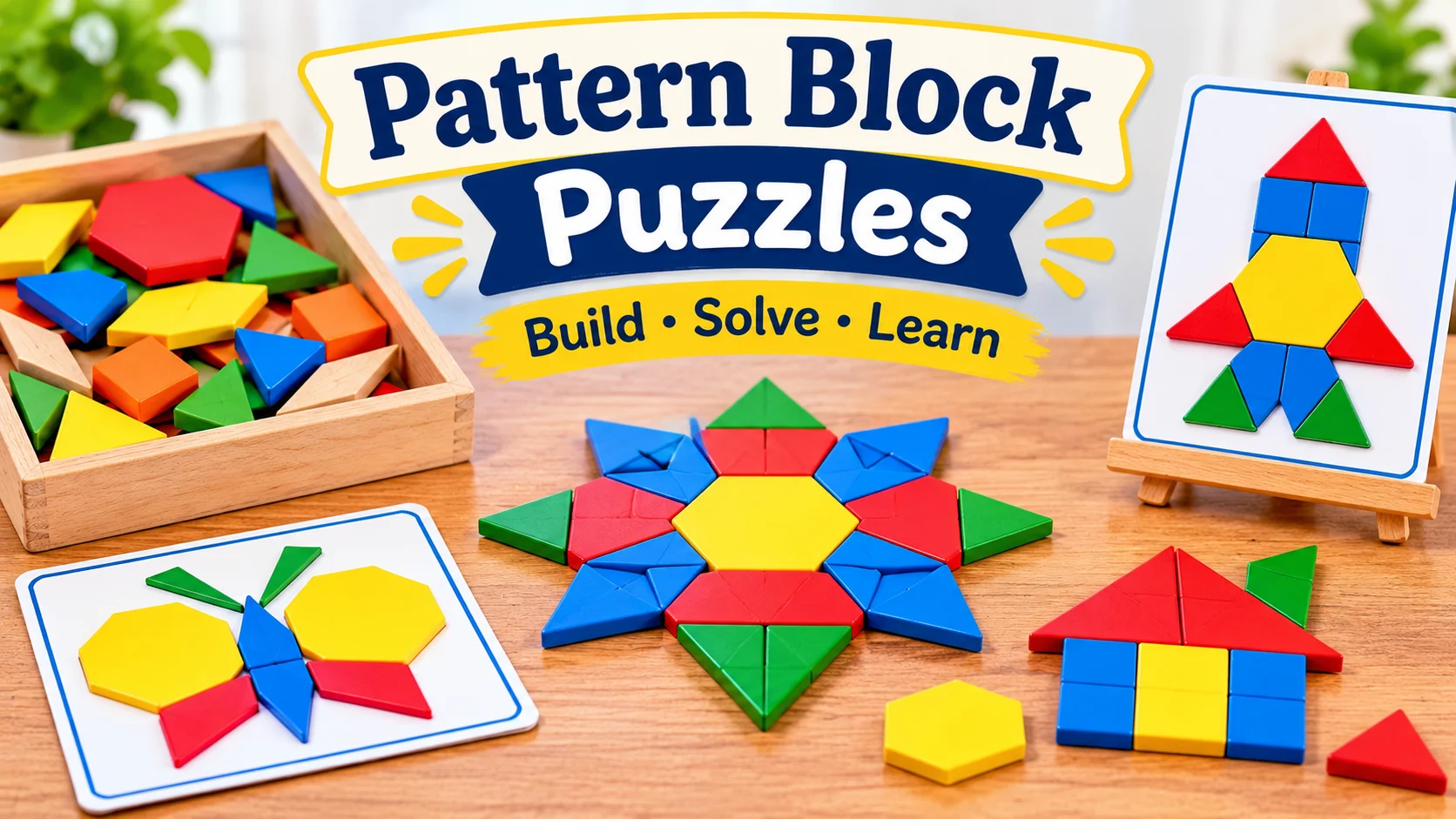
Pattern block puzzles are geometry activities in which you arrange colorful shapes, such as triangles, hexagons, squares, trapezoids, and rhombuses, to complete patterns or create pictures. They help children and adults practice shape recognition, symmetry, spatial reasoning, and problem-solving through hands-on challenges.
Can you turn a collection of simple geometric shapes into a flower, a butterfly, or a perfectly balanced pattern? That’s the idea behind pattern block puzzles.
These activities use geometric pieces that fit together to create larger shapes and designs. Some challenges ask you to copy a picture, while others require you to complete a repeating sequence, identify a missing piece, or discover how many different arrangements are possible.
In this guide, you’ll find original pattern block puzzles with answers, beginner-friendly activities, and more challenging geometry problems. You can solve them with physical pattern blocks or use the shape symbols and diagrams as paper-based exercises.
Whether you’re a parent looking for an engaging activity, a teacher preparing a maths lesson, or an adult who enjoys visual puzzles, these challenges offer a practical way to explore shapes and spatial reasoning.
What Are Pattern Block Puzzles?
Pattern block puzzles are activities that use geometric pieces to form pictures, fill outlines, complete sequences, or solve spatial challenges.
A standard educational pattern block set commonly includes six shapes in different colors. The exact colors can vary between sets.
Triangle
3 sides
Hexagon
6 sides
Square
4 equal sides
Trapezoid
A quadrilateral
Rhombus
4 equal sides
Narrow rhombus
A slanted quadrilateral
Illustrative shape references. Match pieces by their geometry rather than color if your set uses a different color scheme.
Pattern blocks are useful because individual pieces can be rotated, reflected, combined, and rearranged to make new designs. Educational activities use these actions to explore shape properties, patterns, and spatial relationships.
How to Solve Pattern Block Puzzles
Use these four steps when tackling a shape challenge.
- Identify the shapes. Count their sides and compare their angles.
- Look for a rule. Check whether the puzzle uses a repeating sequence, matching outline, or symmetry.
- Rotate and rearrange. A piece may fit after turning it, even when it looks wrong initially.
- Check the whole design. Make sure every required space is filled without overlaps or gaps.
For picture puzzles, begin with obvious corners and straight edges. For pattern sequences, identify the smallest group that repeats.
8 Pattern Block Puzzles to Solve
These original challenges progress from easy shape recognition to more demanding spatial reasoning. You can use physical blocks, draw the shapes on paper, or answer directly from the diagrams.
Puzzle 1 Find the Missing Shape
Easy
Question: Look at the sequence below.
Triangle → Triangle → ?
What shape should come next if the sequence repeats the same shape?
Hint: The first two pieces are identical.
Answer: A triangle.
Why: The sequence repeats one shape. The third item must therefore be another triangle.
Puzzle 2 Complete the Alternating Pattern
Easy
Question: Which shape belongs in the final space?
Triangle, square, triangle, square, ?
Hint: Look at positions 1 and 3, then positions 2 and 4.
Answer: A triangle.
Why: The pattern alternates between triangle and square. The fifth position starts the cycle again.
Puzzle 3 Build a Larger Shape
Easy
Question: Two identical squares are placed side by side, sharing one complete edge. What larger shape do they form?
Two equal squares sharing an edge
Hint: Count the outside edges of the combined figure.
Answer: A rectangle.
Why: The two squares form one longer shape with four outer sides. Its opposite sides are equal and its four angles are right angles.
Puzzle 4 Spot the Shape That Does Not Belong
Medium
Question: Three of these shapes have four sides. One has three sides. Which is the odd one out?
A
B
C
D
Hint: Count the straight sides of each shape.
Answer: A, the triangle.
Why: The triangle has three sides. The square, trapezoid, and rhombus each have four.
Puzzle 5 Find the Symmetry Rule
Medium
Question: A design has a triangle on the left and an identical triangle on the right. The two triangles are mirror images across a vertical line. If the left triangle points toward the center, which way should the right triangle point?
Hint: Imagine folding the design along the vertical line.
Answer: The right triangle points toward the center, in the opposite horizontal direction from the left triangle.
Why: A mirror reflection reverses left and right while preserving the shape and size. Both triangles point inward toward the symmetry line.
Puzzle 6 How Many Triangles?
Medium
Question: A large equilateral triangle is divided into four equal, smaller equilateral triangles by connecting the midpoints of its sides. How many small triangles are there?
Hint: Count each of the four regions inside the large triangle.
Answer: Four small triangles.
Why: Connecting the three side midpoints divides the original triangle into four congruent equilateral triangles.
Puzzle 7 Create a Hexagon
Medium
Question: Imagine a regular hexagon made from six equal equilateral triangles arranged around one central point. How many triangular regions are needed to fill the hexagon?
Hint: Count the outer corners of the regular hexagon.
Answer: Six triangles.
Why: Joining the center of a regular hexagon to its six vertices divides it into six equal triangular regions.
Puzzle 8 The Shape Building Challenge
Hard
Question: You have six identical equilateral triangles. Arrange them edge to edge so that they form one regular hexagon, with no gaps or overlaps. How many triangles should meet at the center?
Hint: Picture a small triangular wedge at each of the hexagon’s six corners.
Answer: All six triangles meet at the center.
Why: A regular hexagon can be divided by joining its center to each of its six vertices. This creates six congruent equilateral triangles.
Extra challenge: Try building the same outline with different permitted sets of pattern blocks. Record each solution and check that every piece fits completely inside the outline.
How to Make Your Own Pattern Block Puzzles
You don’t need a professionally printed worksheet to create a new challenge. A few geometric pieces and a clear goal are enough.
- Choose an outline. Draw a simple shape, animal, flower, or geometric figure.
- Fill it with blocks. Arrange the pieces so their edges meet without gaps or overlaps.
- Remove the color clues. Trace the outline in black and white to make the puzzle harder.
- Create a missing-piece challenge. Cover one region and ask another person to identify the required shape.
- Find another solution. Ask whether the same outline can be filled using a different combination of pieces.
For younger children, begin with colored templates. As their confidence grows, move to outlines without color clues and open-ended “how many ways?” challenges. These approaches are also used in established educational pattern-block activities.
Printable Pattern Block Puzzle Resources
If you want ready-made worksheets instead of drawing your own, these resources offer useful starting points.
Young Mathematicians: Puzzles with Pattern Blocks
Offers three levels, progressing from colored shape-matching puzzles to more challenging shape and arrangement activities.
Early Math California: Pattern Blocks
Includes ideas for shape patterns, symmetry, larger shapes, and partner activities.
University of Northern Iowa: Pattern Block Puzzles
Provides an experience sheet explaining how pattern-block activities support shape recognition and spatial relationships.
These resources complement the original puzzles above. Check each resource’s usage terms before reproducing or distributing its worksheets.
Why Pattern Block Puzzles Are Useful for Learning
Pattern block puzzles make geometry tangible: instead of only reading about shapes, learners can move pieces, compare edges, rotate objects, and test possible solutions.
They can help learners practise:
- Shape recognition: identifying geometric shapes by their properties.
- Spatial reasoning: predicting how pieces fit when turned or rearranged.
- Part-whole relationships: seeing how smaller pieces combine to form larger figures.
- Symmetry: recognizing designs that remain balanced across a line.
- Mathematical communication: explaining why a particular arrangement works.
Educational resources from Early Math California and the Education Development Center describe pattern-block activities for exploring geometry, shape attributes, and spatial relationships.
FAQs
What are pattern block puzzles?
Pattern block puzzles are geometry activities in which learners arrange geometric pieces to fill outlines, complete sequences, create pictures, or solve spatial problems. They are used in early mathematics education and can be adapted for different ages and difficulty levels.
What shapes are used in pattern block puzzles?
A common pattern block set contains triangles, hexagons, squares, trapezoids, and two types of rhombuses. Colors vary by manufacturer. Each shape has distinctive properties that help learners explore geometry and how smaller pieces combine into larger figures.
Are pattern block puzzles good for kindergarten?
Yes. Simple pattern block puzzles help kindergarten learners recognize shapes, compare sizes, follow repeating patterns, and practise spatial reasoning. Begin with colored outlines and a small number of pieces, then gradually introduce puzzles without color clues.
Can you solve pattern block puzzles without physical blocks?
Yes. You can solve many pattern block puzzles using printed outlines, paper cutouts, or digital diagrams. Physical blocks make rotating and rearranging pieces easier, but paper-based activities can still develop shape recognition and geometric reasoning.
Where can I find free printable pattern block puzzles?
The Young Mathematicians website provides pattern block puzzle sets with colored, shape-based, and more challenging activities. Early Math California also offers pattern block activity ideas, including symmetry and shape-building exercises. Check the linked pages for available downloads and usage conditions.
What skills do pattern block puzzles teach?
These puzzles encourage shape recognition, spatial reasoning, symmetry, pattern identification, and understanding how parts form a whole. More challenging tasks can also encourage learners to compare solutions and explain their geometric reasoning.
How do you make pattern block puzzles harder?
Remove color clues, increase the number of pieces, introduce incomplete outlines, or ask learners to find multiple ways to fill the same shape. You can also add restrictions, such as using a specific number of pieces or requiring mirror symmetry.
Conclusion
Pattern block puzzles are a practical way to turn geometric shapes into enjoyable challenges. Start with simple sequences and shape recognition, then progress to symmetry, composite figures, and open-ended building tasks. You can solve the eight original puzzles in this guide using paper diagrams or physical blocks, and you can find additional printable activities through the linked educational resources.
For an extra challenge, ask a friend or student to solve the same outline without color clues. Comparing different valid solutions is often just as valuable as finding the first answer. If you enjoy these activities, explore more geometry and spatial reasoning puzzles next.

Mason Reed is a puzzle writer and enthusiast at Puzzlenexa.com, where he creates engaging puzzles, brain teasers, riddles and problem-solving challenges. His goal is to make every puzzle enjoyable, thought-provoking and rewarding for readers of all ages.