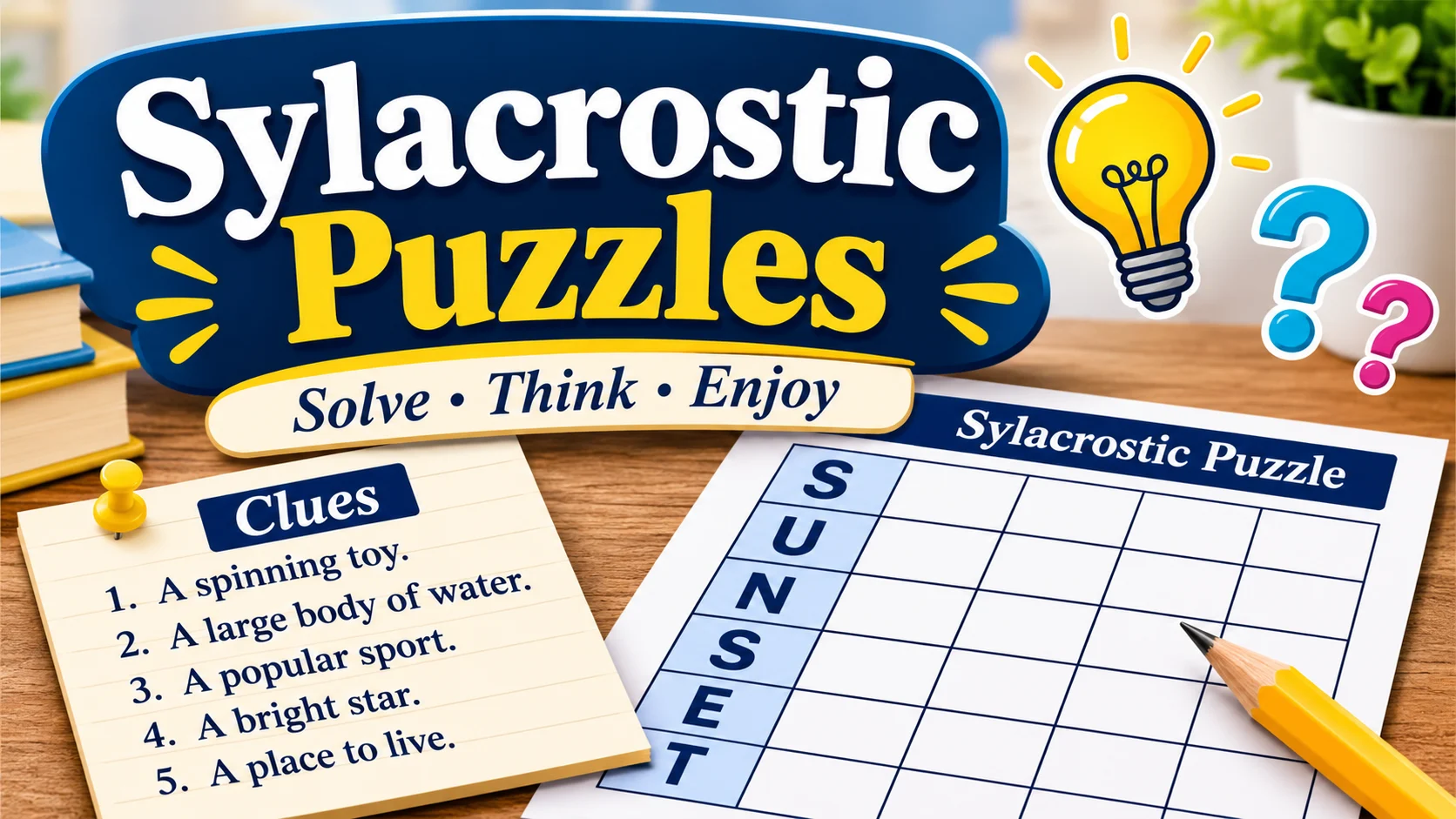
syllacrostic puzzles are word games that challenge you to solve clues and build words from a supplied bank of syllables. Depending on the format, you may also need to match letter counts, use every syllable exactly once, or uncover a hidden message. This guide explains the basic rules and provides ten original practice clues with hints and solutions.
A syllacrostic is a word puzzle built around syllables and clue-solving. Instead of constructing an answer from individual letters, you combine larger word units to form the intended word.
A typical syllacrostic may include four elements:
- Word clues: Definitions or descriptions of the answers.
- Letter counts: The required number of letters in each answer.
- Syllable counts: The number of spoken syllables in each word.
- Syllable bank: The available syllables used to build the answers.
In shared-bank versions, each supplied syllable is used according to the puzzle’s rules, often exactly once. Some versions also use selected letters from the completed answers to reveal a hidden word, quotation, or message.
The examples below use a shared bank of syllables, with each tile used once. They are designed to teach the word-building method before you try more elaborate formats.
How to Solve a Syllacrostic Puzzle
1. Read the clue carefully.
Identify the meaning before looking for possible syllable combinations. A clue about a colorful arc after rain, for example, points toward a specific kind of natural phenomenon.
2. Check the syllables.
Say a likely answer aloud and divide it into spoken parts. The pieces must match the available bank and the stated syllable count.
3. Verify the letter count.
Check the spelling and total number of letters. A word that matches the definition but fails the length requirement cannot be the intended answer.
4. Eliminate used tiles.
Mark each confirmed syllable as used. The remaining tiles provide clues to answers you have not solved yet.
10 Syllacrostic Puzzles With Hints
Your syllable bank
Use the following 20 tiles to solve all ten clues. Each answer has two syllables, and each tile is used exactly once.
Shared syllable bank · 20 tiles
sun
light
rain
bow
cup
cake
tooth
brush
box
foot
ball
bed
room
star
fish
pop
corn
back
pack
0 of 20 tiles marked
Reset
Tap a tile to mark it as used. This is a manual tracker, not an automatic answer checker.
Puzzle 1 The Light Source
Difficulty: Easy
Question: What do we call the illumination that comes from the sun?
Letters: 8
Syllables: 2
Hint: Combine the name of our star with a word meaning illumination.
Puzzle 2 A Colorful Arc
Difficulty: Easy
Question: What colorful arc may appear in the sky when sunlight interacts with water droplets?
Letters: 7
Syllables: 2
Hint: The first syllable describes the weather; the second can mean a curved weapon.
Puzzle 3 A Sweet Treat
Difficulty: Easy
Question: What small cake is commonly baked in an individual paper liner?
Letters: 7
Syllables: 2
Hint: The first syllable names a drinking vessel.
Puzzle 4 Daily Hygiene
Difficulty: Easy
Question: What tool has bristles and is used to clean your teeth?
Letters: 10
Syllables: 2
Hint: Combine the part of your mouth being cleaned with the tool’s action or form.
Puzzle 5 The Delivered Letter
Difficulty: Easy
Question: What receptacle at a home can hold letters delivered by a postal worker?
Letters: 7
Syllables: 2
Hint: Combine the name of delivered correspondence with a container.
Puzzle 6 On the Playing Field
Difficulty: Easy
Question: What word names the ball based sport played with the feet in many parts of the world?
Letters: 8
Syllables: 2
Hint: Put together the body part used to kick and the object being kicked.
Puzzle 7 Where You Sleep
Difficulty: Easy
Question: What room in a home is primarily used for sleeping?
Letters: 7
Syllables: 2
Hint: The first syllable is a piece of furniture.
Puzzle 8 A Star-Shaped Sea Animal
Difficulty: Medium
Question: What marine animal is commonly known for its star like shape?
Letters: 8
Syllables: 2
Hint: Combine a familiar shape with the name of an aquatic animal.
Puzzle 9 A Popping Snack
Difficulty: Easy
Question: What snack is made by heating special corn kernels until they burst open?
Letters: 7
Syllables: 2
Hint: The first syllable describes the sound of a kernel bursting.
Puzzle 10 Carrying Your Books
Difficulty: Medium
Question: What bag is worn on the back to carry books, supplies, or travel essentials?
Letters: 8
Syllables: 2
Hint: Combine a word for the rear of the body with a word associated with packing or carrying items.
Syllacrostic Answer Key
Try all ten clues before revealing the answers. Each solution below includes the syllable combination and a short explanation.
Ready to check your work?
Reveal all ten answers and their explanations.
Reveal answers
How to Make Your Own Syllacrostic Puzzle
Creating your own syllacrostic is a useful way to practice vocabulary and puzzle design.
- Choose a set of familiar words. Start with words that divide naturally into clear syllables.
- Write one clue per word. Define each word without including its answer in the clue.
- Record the syllable pieces. Split the words into the pieces you intend solvers to use.
- Build a shared bank. Mix the tiles together and state whether each must be used exactly once.
- Add letter and syllable counts. These constraints help solvers distinguish plausible answers from incorrect guesses.
- Test the completed puzzle. Reconstruct every answer from the bank, verify the spelling, and check that no tile is missing or duplicated.
If you want to create a traditional hidden message version, add a clearly explained rule for extracting letters from the solved answers. Do not imply that a hidden message exists unless the puzzle actually contains one.
Tips for Solving More Difficult Word Puzzles
- Start with precise clues. Specific definitions reduce the number of possible answers.
- Use word length as a filter. Eliminate words that have the wrong number of letters.
- Say candidate words aloud. Pronunciation helps identify syllable boundaries.
- Track confirmed tiles. Keep a visible record of the pieces already used.
- Revisit unsolved clues. Each completed word reduces the available options.
- Check the rules before assuming a pattern. Not every syllacrostic uses a hidden message or the same extraction method.
Syllable division can vary slightly with pronunciation and accent, so well designed puzzles should favor familiar words and unambiguous clues.
Why Are Syllacrostic Puzzles Useful?
Syllacrostic puzzles bring together vocabulary, spelling, pronunciation, and deduction in one activity. Students can use them to explore how words are constructed, while families and adult word game enthusiasts can enjoy the challenge of finding combinations that satisfy multiple constraints.
They are especially effective when the rules are explicit and the answer key explains why each word fits. Instead of relying on guesswork, solvers learn to check the clue, word length, syllable count, and remaining bank together.
FAQs
What is the difference between a Syllacrostic and a syllable puzzle?
A syllable puzzle is a broad category of word activity involving syllable recognition, division, or arrangement. A Syl acrostic is a more specific puzzle format that uses clues and syllables to construct answers, sometimes with an additional hidden message mechanism.
How many syllables should a Sllyacrostic answer have?
There is no universal number. The required syllable count depends on the puzzle’s design. Some collections use two syllable words for beginners, while more challenging puzzles can include longer words with three or more syllables.
Do you have to use every syllable in a Syllacrostic?
That depends on the rules. Many shared bank versions require every supplied syllable to be used exactly once. Other variants may allow unused pieces or use different construction rules, so always read the instructions before solving.
Are Syllacrostic puzzles suitable for children?
Yes. Simple versions can introduce children to word construction, pronunciation, and vocabulary. Choose familiar words, short clues, and a manageable syllable bank. Older students can try longer answers, less obvious definitions, or puzzles involving hidden messages.
Can Syllacrostic puzzles have hidden messages?
Yes. Some versions use selected letters from the completed answers to reveal a word, quotation, or phrase. Others focus exclusively on solving the clues using the supplied syllables. The extraction rule should always be stated clearly.
How can I make a Syllacrostic puzzle harder?
Use less familiar vocabulary, longer answers, more similar looking syllable options, or more complex clues. You can also add a hidden-message mechanism. Keep every clue fair and make sure the available tiles still permit a consistent solution.
Where can I find printable Syllacrostic puzzles?
Look for educational word puzzle resources and specialist puzzle collections. A useful printable should include the clues, the complete syllable bank, any required letter and syllable counts, and a separate answer key.
Conclusion
syllacrostic puzzles offer a distinctive way to enjoy wordplay while practicing vocabulary and logical deduction. Start with simple clues, match the available syllables carefully, and check every answer against its spelling and meaning. Once you are comfortable with shared syllable banks, try creating your own challenges or exploring acrostics and other word games. You can also adapt the format for a classroom or family activity by printing the clues separately from the answer key. The best puzzles reward careful thinking, clear rules, and the satisfying discovery of a word that fits every constraint.

Mason Reed is a puzzle writer and enthusiast at Puzzlenexa.com, where he creates engaging puzzles, brain teasers, riddles and problem-solving challenges. His goal is to make every puzzle enjoyable, thought-provoking and rewarding for readers of all ages.