D&D puzzles are challenges that ask players to solve riddles, interpret clues, manipulate objects, recognize patterns, or work together to overcome obstacles in a fantasy adventure. These 25 original Dungeons & Dragons puzzle ideas include answers, hints, and Dungeon Master guidance, with a mix of easy, medium, and hard challenges suitable for dungeon rooms, temples, magical doors, and treasure chambers.
A well-designed D&D puzzle can turn an ordinary dungeon room into a memorable moment of discovery. Instead of defeating another group of enemies, players might need to decode an ancient inscription, redirect beams of magical light, balance enchanted objects, or figure out why a seemingly impossible door refuses to open.
This collection of D&D puzzles is designed for Dungeon Masters who want practical challenges they can adapt to their campaigns without extensive preparation. Each puzzle includes a question or setup, a helpful hint, an answer, and an explanation so you can run it confidently at the table.
You’ll find straightforward riddles for new players, logic challenges for thoughtful groups, environmental puzzles for exploration, and more difficult magical mechanisms for experienced adventurers. The puzzles are system-neutral ideas for Dungeons & Dragons, so you can adapt their checks, spells, clues, and consequences to your edition and party.
How to use these D&D puzzles
- Choose the right difficulty. Start with an easy challenge if your players are unfamiliar with puzzles.
- Give clues fairly. Important information should be discoverable through observation, experimentation, or conversation.
- Reward creative thinking. Accept a sensible alternative solution when the players explain how it works.
- Avoid unnecessary dead ends. A failed attempt can cost time, trigger a harmless effect, or reveal another clue rather than permanently blocking the adventure.
- Adapt the mechanics. Use ability checks, tools, spells, or role-playing when they fit your campaign.
Easy D&D puzzles for beginners
These five puzzles work well in introductory adventures, small dungeons, and rooms that should not interrupt the main story for too long.
Puzzle 1 The Three Silent Bells
Easy
Question
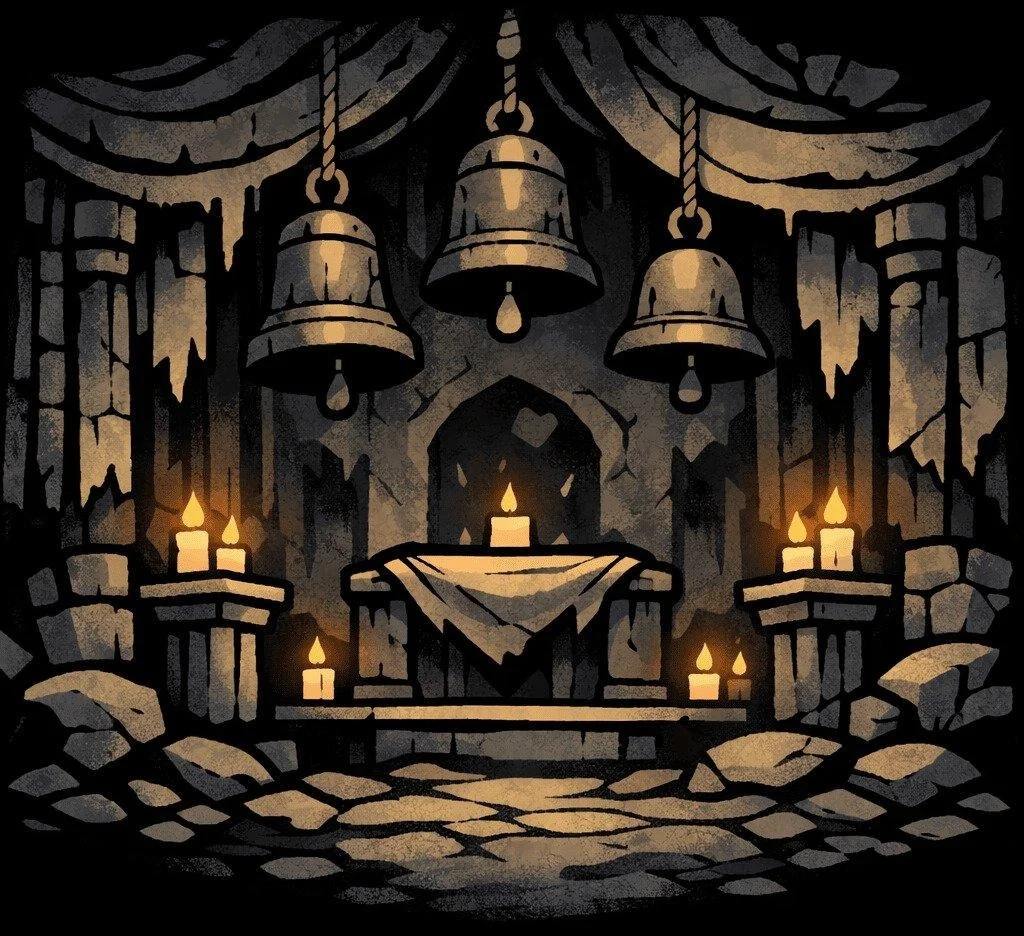
Three bells hang above a sealed stone door. An inscription reads:
“Ring the one that has no voice, and silence shall speak.”
One bell is bronze, one is silver, and one is made of dark glass. Which bell should the adventurers ring?
Hint: Think about which bell cannot make a normal ringing sound.
Answer: The dark-glass bell.
Why: The puzzle establishes that the glass bell is the silent one. Ringing or tapping it causes a magical tone to sound from inside the door, unlocking it.
DM tip: If players try the bells experimentally, let them discover that the bronze and silver bells ring normally. The inscription should guide the solution rather than require guessing.
Puzzle 2 The Door That Counts
Difficulty: Easy
Question
A stone door bears four symbols: a wolf, a spider, a raven, and a dragon. Below them is the inscription:
“Count the legs, then choose the number that belongs to none.”
The door has three buttons marked 2, 4, and 8. Which button should the party press?
Hint: Count the legs of the four creatures, then compare the total with the available numbers.
Answer: The button marked 8.
Why: A wolf has 4 legs, a spider has 8, a raven has 2, and a dragon is depicted with 4 legs in the carving. The total is 18, so the wording alone does not identify a unique answer unless the intended rule is clarified.
DM-ready revision: To make the puzzle fair, change the inscription to “Choose the number of legs on the spider.” The correct button is 8.
DM tip: Always test number puzzles before using them. A small wording change can turn an ambiguous challenge into a satisfying one.
Puzzle 3 The Traveler’s Shadow
Easy
Question
A door bears the words:
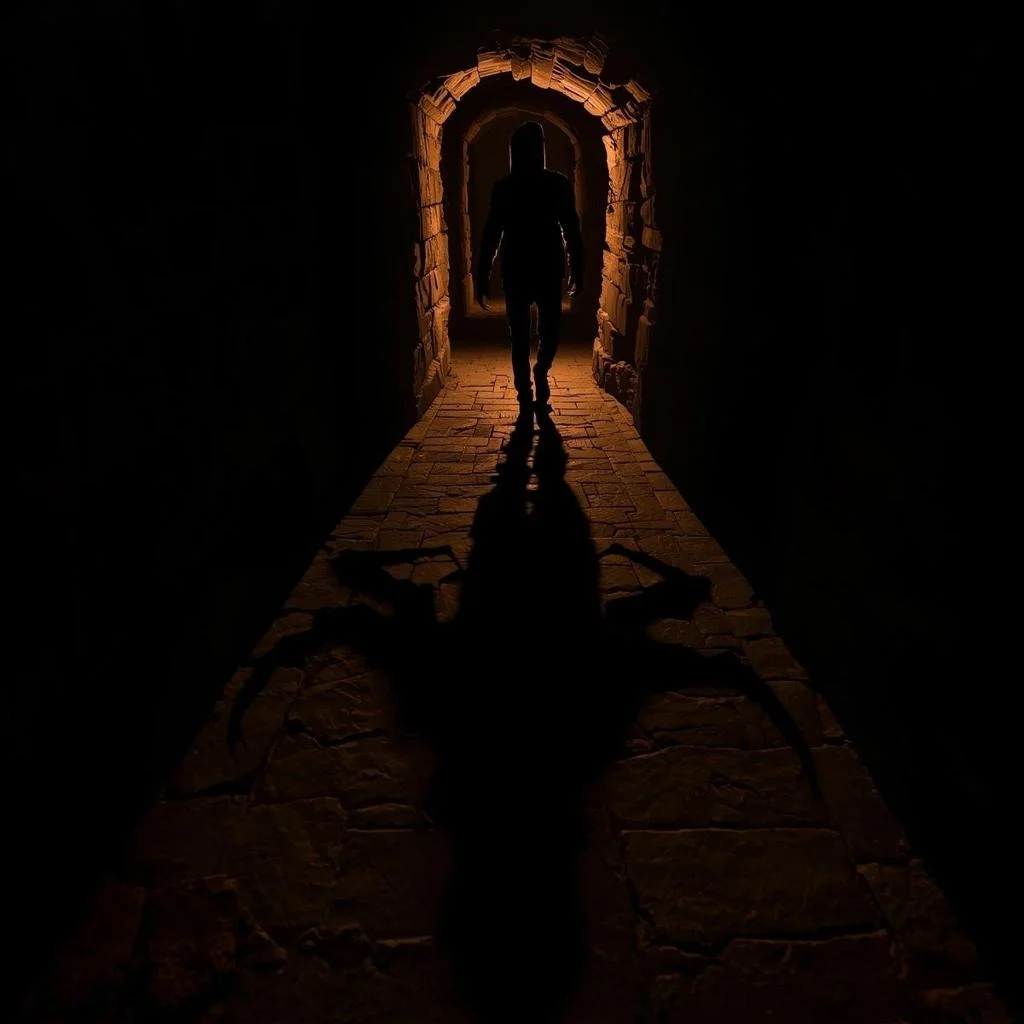
“I follow the living, grow long when the sun is low, and vanish when darkness claims the light. What am I?”
Hint: Look at the floor or wall when a torch is nearby.
Answer: A shadow.
Why: A shadow follows an object when light is blocked. Its shape and length change with the position of the light source.
DM tip: Let the players use a torch, lantern, or magical light to interact with the door. Their shadow touching a carved mark can trigger the mechanism.
Puzzle 4 The Honest Statue
Difficulty: Easy
Question
Two statues guard a treasure room. One always speaks the truth, and the other always lies. One passage leads to the treasure; the other leads to a harmless dead end. The party may ask either statue one yes-or-no question.
What question guarantees that the party identifies the treasure passage?
Hint: Ask what the other statue would say.
Answer: Point to one passage and ask either statue, “Would the other statue say this passage leads to the treasure?” Choose the opposite of the answer.
Why: The truthful statue accurately reports the liar’s false answer, while the lying statue lies about the truthful statue’s correct answer. Both identify the wrong passage, so the party should take the opposite route.
DM tip: Make the statues’ behavior consistent and clearly established before the players ask their question.
Puzzle 5 The Missing Word
Difficulty: Easy
Question
An ancient inscription reads:
STONE STONE ? STONE
A note beside it says:
“Name what remains when the word is broken apart.”
What word belongs in the gap?
Hint: Consider a word that can describe what stone becomes after it breaks into tiny pieces.
Answer: Sand.
Why: The intended wordplay connects stone with the smaller particles produced by weathering and erosion. The repeated words and inscription are thematic clues, not a strict mathematical sequence.
DM tip: Use this as a flexible, low-stakes inscription puzzle. If your players interpret the clue differently, accept another answer that fits the inscription’s fictional context.
Medium D&D logic puzzles
These puzzles require players to compare clues, test assumptions, or combine multiple pieces of information.
Puzzle 6 The Four Elemental Pedestals
Medium
Question
Four pedestals hold a flame, a bowl of water, a stone, and a feather. An inscription reads:
“The lightest must rise first. The heaviest must rest last.”
The pedestals must be activated in order from lightest to heaviest. What is the sequence?
Hint: Compare the physical objects, not their magical importance.
Answer: Feather, flame, water, stone.
Why: The feather is the lightest physical object, while the stone is the heaviest. The intended sequence treats the flame as lighter than the bowl of water.
DM tip: Make the water bowl visibly substantial and the flame small. If you want a strictly objective ordering, provide weights or explicitly state the intended comparison rules.
Puzzle 7 The Four Torches
Difficulty: Medium
Question
A chamber contains four unlit torches. Each torch has a rune beneath it: sun, moon, star, and dawn. The wall reads:
“Night comes before the star; dawn follows the night; the sun is last.”
In what order should the torches be lit?
Hint: Draw the clues as a sequence.
Answer: Moon, star, dawn, sun.
Why: The moon comes before the star, the star comes before dawn, and the sun is last. Together, these clues establish the order.
DM tip: Have each correctly lit torch illuminate the next rune. A wrong order can simply extinguish the torches and reset the puzzle.
Puzzle 8 The Alchemist’s Bottles
Difficulty: Medium
Question
Three bottles contain a healing potion, a sleeping draught, and harmless colored water. Their labels read:
- Red: “The healing potion is not here.”
- Blue: “The sleeping draught is here.”
- Green: “The healing potion is in the red bottle.”
Exactly one label is true. Which bottle contains the healing potion?
Hint: Test each possible location and count the true statements.
Answer: The green bottle.
Why: If healing is in green, the red label is true, the blue label is false, and the green label is false. That gives exactly one true label.
DM tip: Make the colors and labels easy to inspect. Players should be able to reason their way through the puzzle without drinking unknown liquids.
Puzzle 9 The Bridge of Three Questions
Difficulty: Medium
Question
A magical bridge appears only when the party answers three questions correctly:
- What can be given but never physically held?
- What becomes more useful when shared?
- What can be broken without being touched?
Hint: Think of promises, knowledge, and human relationships.
Answers:
- A promise.
- Knowledge.
- Trust.
Why: These answers fit the intended figurative meanings. The bridge tests conceptual understanding rather than factual knowledge.
DM tip: Accept other answers if players provide a convincing explanation. The goal is collaborative reasoning, not guessing the DM’s exact wording.
Puzzle 10 The Clockwork Guardians
Medium
Question
Four guardians face the center of a room. Each can rotate to face north, east, south, or west. An inscription says:
“No guardian may face its neighbor, and all must face a different direction.”
The guardians stand in a square, and neighboring guardians must not face toward one another. How can the party arrange them?
Hint: The guardians do not have to face the center.
Answer: Have each guardian face outward from the square.
Why: Each guardian faces away from the central space and from its immediate neighbors. The outward arrangement satisfies the intended spatial rule without requiring a specific rotational sequence.
DM tip: Use a small map or movable tokens so players can see how their choices affect the mechanism.
Puzzle 11 The Librarian’s Sequence
Difficulty: Medium
Question
A magical library has books numbered 2, 6, 12, 20, and 30. The next book must be placed on the empty shelf.
What number belongs next?
Hint: Compare the differences between consecutive numbers.
Answer: 42.
Why: The differences are 4, 6, 8, and 10. The next difference is 12, so 30+12=42. Equivalently, the sequence follows n(n+1): 1×2, 2×3, 3×4, and so on, with the displayed sequence beginning at 1×2.
DM tip: Make the number pattern visible through the books’ markings. This is a useful puzzle for a wizard’s study or enchanted archive.
Puzzle 12 The Two Candles
Difficulty: Medium
Question
A sealed door opens after exactly 45 minutes. The party has two magical candles. Each candle burns completely in 60 minutes, but neither burns at a constant rate.
How can the adventurers measure 45 minutes?
Hint: Lighting a candle at both ends changes the total burn time.
Answer: Light candle A at both ends and candle B at one end. When A finishes, 30 minutes have passed. Then light the other end of B. It will finish in another 15 minutes.
Why: Burning A at both ends makes it finish in 30 minutes despite its uneven burn rate. At that moment, B has burned for 30 minutes of its total 60-minute burn time. Lighting B at both ends makes its remaining portion finish in 15 minutes. Total: 45 minutes.
DM tip: This is a classic timing-mechanism concept. If using it in a campaign, describe the candles’ magical behavior clearly enough that players can reason from the stated rules.
Puzzle 13 The Silent Library
Difficulty: Medium
Question
The party enters a library where speaking aloud causes every book to vanish until the room becomes silent again. A locked cabinet displays the message:
“Ask no question, yet receive an answer.”
How can the party discover the cabinet’s code without speaking?
Hint: The books contain clues, and speech is not the only way to communicate.
Answer: The players can write questions, point to relevant book titles, or arrange written symbols to communicate their discoveries.
Why: The puzzle tests creative communication under a constraint. The message suggests that answers can be obtained without verbal questions.
DM tip: Have the environment respond to written or gestured communication. Don’t punish players for failing to guess a single prescribed method.
Puzzle 14 The Moonlit Tiles
Medium
Question
Nine floor tiles form a three-by-three grid. Each tile depicts a moon phase. A wall inscription reads:
“Walk from darkness to fullness, never skipping a phase.”
The room contains three consecutive moon phases marked on a nearby diagram: new moon, crescent moon, and full moon. Which three tiles must the adventurers step on?
Hint: Follow the three phases shown on the diagram in the stated order.
Answer: New moon, crescent moon, full moon.
Why: The inscription defines the required sequence, and the diagram supplies the allowed phases. The tiles must be arranged so that the party can step through them in order.
DM tip: Place the three correct tiles in a connected path. If you want a harder version, hide the phase diagram in another room.
Puzzle 15 The Merchant’s Coins
Difficulty: Medium
Question
A ghostly merchant offers three pouches. One contains 10 gold coins, one contains 20, and one contains 30. The labels read:
- Pouch A: “The largest sum is here.”
- Pouch B: “This pouch has fewer coins than A.”
- Pouch C: “A has 20 coins.”
Exactly one label is true. How many coins are in each pouch?
Hint: Test the possible placements and count the true labels.
Answer: This puzzle needs an additional constraint to guarantee a unique solution.
Why: The condition “exactly one label is true” does not, by itself, uniquely determine the placement of the three coin amounts. Several arrangements can satisfy it, so the original setup is underdetermined.
DM-ready revision: Add the clue, “Pouch B contains 10 coins.” Then A and C must contain 30 and 20 coins respectively for exactly one label to be true? Check the labels: A’s statement is true if A=30; B’s statement is false if B=10 and A=30; C’s statement is false if A=30. Thus exactly one statement is true.
DM tip: This is a useful reminder to test every arrangement when using truth-label puzzles.
Hard D&D puzzles for experienced adventurers
These five challenges are better suited to ancient temples, powerful magical vaults, and story-critical encounters. Give players time to investigate and provide additional clues if the group becomes stuck.
Puzzle 16 The Mirror of Four Truths
Hard
Question
Four runes appear on a mirror: flame, wave, leaf, and stone. An inscription reads:
“Fire feeds on what water fears; earth holds what leaves abandon; the answer is the one that survives all four.”
Which rune must the adventurers touch?
Hint: Consider the shared theme of the elements rather than their physical properties alone.
Answer: This puzzle requires a defined rule to be fair. The inscription is poetic, but it does not establish a unique solution.
DM-ready revision: Place four rune cards on the mirror and add a clear clue: “Touch the element that remains when fire is extinguished, leaves fall, and stone is worn away.” The intended answer can be water, provided the campaign establishes water as the enduring element in this magical test.
Why: The added context makes the expected interpretation clearer. Without it, several symbolic readings are possible.
DM tip: Poetic clues are most effective when earlier discoveries establish what their symbolism means in your campaign.
Puzzle 17 The Prisoner’s Three Levers
Difficulty: Hard
Question
A chamber has three levers: A, B, and C. A plaque explains their effects:
- A opens the outer gate.
- B disables the magical barrier.
- C resets every lever.
The gate cannot open while the barrier is active. The barrier cannot be disabled while the reset mechanism is engaged. Lever C is currently engaged, and pulling it resets all levers to their starting positions.
How can the party open the gate?
Hint: Consider which action must happen last.
Answer: First disengage the reset mechanism using the chamber’s manual release, then disable the barrier with B, and finally activate A to open the gate.
Why: The manual release is an essential part of the revised setup. Without it, the stated lever rules alone may not permit progress.
DM tip: Place a visible manual release in the room, perhaps behind a movable stone panel. The puzzle rewards observation and planning instead of forcing the party into an impossible mechanism.
Puzzle 18 The Dragon’s Equation
Difficulty: Hard
Question
A dragon’s vault displays three runes:
- Crown = 5
- Claw = 3
- Scale = 2
The inscription says:
“Multiply the crown by the claw, subtract the scale, and speak the result.”
What number opens the vault?
Hint: Follow the instructions in order.
Answer: 13.
Why: 53-2=13.
DM tip: If the party has already found the rune values elsewhere, this is a satisfying final step in a larger treasure hunt.
Puzzle 19 The Chamber of Reversed Time
Difficulty: Hard
Question
A magical room shows three inscriptions:
- “Yesterday, the door was closed.”
- “Tomorrow, the door will be open.”
- “Today, neither statement is true.”
The party must identify which inscription describes the current state of the door.
Hint: Separate the statements about different times from the statement about the present.
Answer: The third inscription describes the present state according to the room’s rules, but its claim is self-contradictory if interpreted as an ordinary factual statement.
Why: The original wording does not specify how the room evaluates truth across time. To make this playable, define the rule: the third inscription is a magical instruction, not a factual statement. The door opens when the party identifies that distinction.
DM tip: Time puzzles need explicit fictional rules. Give players a chance to learn those rules before asking them to solve the final challenge.
Puzzle 20 The Five Relics
Hard
Question
Five relics rest on an altar: a key, crown, orb, chalice, and dagger.
The clues say:
- The key must come before the crown.
- The orb must come after the crown.
- The chalice must come before the dagger.
- The dagger must come after the orb.
What is the only valid order?
Hint: Draw arrows from each relic to the relic that must follow it.
Answer: There is no unique order. One valid order is key, crown, chalice, orb, dagger.
Why: The clues impose ordering constraints but leave the relative position of the chalice and orb partly open. Other valid sequences exist, so the puzzle cannot honestly claim one unique answer.
DM-ready revision: Add the clue, “The chalice is immediately before the orb.” Then the intended order becomes key, crown, chalice, orb, dagger.
DM tip: Use a physical altar diagram and let players move tokens. Constraint puzzles work best when every necessary relationship is stated explicitly.
Magical door puzzles for D&D
These five puzzles focus on doors, locks, runes, and magical mechanisms. They’re especially useful when the party needs a memorable obstacle between two areas of a dungeon.
Puzzle 21 The Door That Hears No Names
Difficulty: Easy
Question
A magical door refuses to open when anyone says a person’s name. Its inscription reads:
“Speak of what you seek, but never of who seeks it.”
How can the party open it?
Hint: Describe the goal rather than the adventurers.
Answer: The party must state its purpose without using names. For example: “We seek the lost library.”
Why: The door reacts to names, not intentions. The inscription explicitly directs the party toward describing its goal.
DM tip: Reward a clever paraphrase. The party should not need to guess a particular sentence.
Puzzle 22 The Rotating Rune Lock
Medium
Question
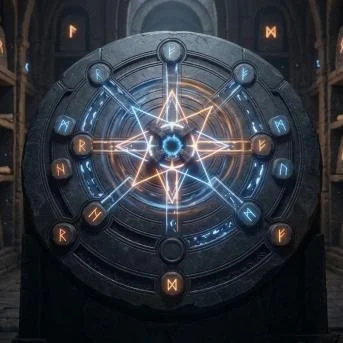
Four discs show symbols for water, fire, earth, and air. A nearby inscription says:
“From the ground, rise to the sky; the flame must follow the flow.”
What order should the discs display?
Hint: Begin with the element associated with the ground and finish with the one associated with the sky.
Answer: Earth, water, fire, air.
Why: The ground suggests earth, the flow suggests water, the flame identifies fire, and the sky suggests air. The inscription is a thematic sequence rather than a universal rule of elemental magic.
DM tip: Introduce the same elemental associations earlier in the dungeon so players have a fair chance to infer the intended order.
Puzzle 23 The Key That Must Not Turn
Difficulty: Medium
Question
A golden key hangs beside a sealed door. The inscription says:
“The key opens the way only when it refuses to turn.”
How can the party unlock the door?
Hint: Consider what the key might do without being inserted into the lock.
Answer: Place the key into a shallow slot beside the door without rotating it.
Why: The door’s mechanism is designed to recognize the key’s presence rather than a turning motion. The inscription directly points to this unusual operation.
DM tip: Describe the slot and its matching shape clearly. Let players inspect the door before deciding what to do.
Puzzle 24 The Five Light Beams
Difficulty: Hard
Question
A chamber contains five mirrors and a crystal that emits a beam of light. The party must direct the beam into a receiver above the exit. The room’s rules are:
- Each mirror reflects the beam at a right angle.
- The beam begins facing north.
- The receiver lies directly east of the crystal.
- No mirror can be moved once the beam is activated.
How can the party solve the room?
Hint: Map the room before activating the crystal.
Answer: Arrange the mirrors in a path that turns the beam from north toward east, using the right-angle reflection rule.
Why: The puzzle needs a room layout showing the mirror positions and receiver location to determine an exact arrangement. The written rules establish the mechanism but not the unique solution.
DM-ready revision: Provide a square grid with the crystal in the southwest corner and the receiver in the northeast corner. Mark each mirror’s possible location and orientation, then ensure the intended path can be traced using the stated reflection rule.
DM tip: This puzzle is strongest as a physical map challenge. Don’t expect players to infer an exact solution from a description that omits the room’s geometry.
Puzzle 25 The Final Seal
Hard
Question
Three seals guard the final vault: the Sun, the Moon, and the Star. A message reads:
“The Sun cannot rise before the Moon has fallen. The Star shines only after the Sun. Break no seal before its time.”
In what order should the party activate the seals?
Hint: Translate each statement into a rule about which seal must come first.
Answer: Moon, Sun, Star.
Why: The Moon must be activated before the Sun, and the Star must follow the Sun. The two clues establish a single sequence.
DM tip: Let each seal glow when activated correctly. If the players choose the wrong order, have the seals reset and reveal a small additional clue rather than making the entire adventure unwinnable.
Tips for running D&D puzzles successfully
A puzzle should create an interesting decision, not stop the campaign indefinitely. These practical techniques help Dungeon Masters make challenges rewarding.
- Use clues in layers. Start with an environmental hint, then offer a more direct clue if players investigate.
- Allow multiple approaches. A spell, clever tool use, or creative character ability might bypass a mechanism in a way that fits the fiction.
- Make failure interesting. A wrong answer might awaken a guardian, drain a magical charge, or trigger a harmless reset.
- Connect puzzles to the story. A dragon’s vault, forgotten temple, or wizard’s library should feel connected to the world around it.
- Test every solution. Check that the clues support the intended answer and that any claimed unique solution really is unique.
- Keep the party involved. Give different characters opportunities to notice clues, recall lore, experiment, and contribute ideas.
Can You Solve It? A bonus challenge
Before reading the solution, try this short puzzle with your party.
The Three Doors
One door leads to treasure, one to a sleeping dragon, and one to a dead end. Three signs are displayed:
- Door A: “The treasure is not behind Door B.”
- Door B: “The treasure is behind Door C.”
- Door C: “The treasure is not behind this door.”
Exactly one sign is true. Which door leads to the treasure?
Think through each possible location before revealing the answer.
Reveal solution
People Also Ask
What are D&D puzzles?
D&D puzzles are interactive challenges in Dungeons & Dragons that require players to solve riddles, interpret clues, recognize patterns, or manipulate objects. Dungeon Masters use them to add variety to exploration, reveal story information, guard treasures, and encourage teamwork.
How do you make a good D&D puzzle?
A good D&D puzzle has clear rules, discoverable clues, and a defensible solution. Test the intended answer before the session, consider alternative interpretations, and provide hints when necessary. The puzzle should challenge the players without making progress depend on guessing the Dungeon Master’s thoughts.
What are some easy D&D puzzles for beginners?
Easy D&D puzzles include straightforward riddles, symbol-matching doors, simple number sequences, and mechanisms activated by following an inscription. Begin with one clear clue and a solution players can explain in a sentence. These puzzles are particularly useful for first-time players.
How do you create difficult D&D puzzles?
Difficult D&D puzzles can combine several clues, logical constraints, environmental mechanisms, or interconnected rooms. Increase complexity gradually and ensure every required rule is discoverable. A challenging puzzle should reward careful reasoning, not depend on information the players could not reasonably obtain.
Should D&D puzzles have only one answer?
Not always. Logic puzzles and mechanisms with a defined sequence often benefit from one verifiable solution, while riddles and role-playing challenges can support several reasonable answers. Decide in advance whether you require a specific answer or will accept creative alternatives.
How many puzzles should a D&D dungeon have?
There is no universal ideal number. A short dungeon might contain one memorable puzzle, while a larger adventure could include several challenges with different purposes. Consider your session length, party preferences, and the importance of maintaining momentum through exploration, role-playing, and combat.
What happens if players cannot solve a D&D puzzle?
Offer another clue, allow an appropriate ability check, or introduce an alternative route. You can also let experimentation reveal information at a cost. Avoid making the entire campaign depend on solving a single puzzle unless you have a reliable way for the party to progress.
Can magic solve D&D puzzles?
Yes. Spells and magical abilities should be considered when designing puzzles. Some challenges can reward a creative spell use, while others may involve magical rules that players can investigate. Make sure any limitations are explained within the game rather than introduced arbitrarily after a player finds a solution.
How do you make D&D puzzles more immersive?
Connect puzzles to the location’s history, inhabitants, and purpose. Use inscriptions, physical objects, sounds, lighting, and environmental changes to communicate clues. A puzzle feels more immersive when its solution makes sense within the fictional world rather than appearing as an unrelated brain teaser.
Are D&D puzzles suitable for one-shot adventures?
Yes. For a one-shot, choose puzzles that can be explained and solved relatively quickly, with clear clues and satisfying results. One central puzzle or two short challenges can add variety without consuming the time needed for the adventure’s main objective.
Conclusion
The best D&D puzzles give players a reason to examine their surroundings, discuss possibilities, and celebrate a solution together. Use these 25 challenges as starting points for dungeon rooms, enchanted doors, mysterious temples, and treasure vaults, adapting their clues and mechanics to your campaign.
Before running a puzzle, check that its answer follows from the information provided. If you want to increase the difficulty, add interconnected clues or make the environment part of the solution rather than simply hiding the answer. For your next adventure, consider pairing these challenges with a dedicated collection of D&D riddles or a guide to designing memorable dungeon traps. Share your favorite puzzle ideas with your gaming group and see which challenges spark the most creative solutions.

Mason Reed is a puzzle writer and enthusiast at Puzzlenexa.com, where he creates engaging puzzles, brain teasers, riddles and problem-solving challenges. His goal is to make every puzzle enjoyable, thought-provoking and rewarding for readers of all ages.